By: Wilfredo Santa Gomez MD (WSantaKronos Virtual Laboratory)
Report: Mathematical Foundations for Advancing PEECTS in Light of Quantum Teleportation and Elastic Time Theory. Wilfredo Santa Gomez
[…previous content preserved…]
PEECTS-ETC Model for Dark Matter Detection in the Ionosphere
Objective:
To extend the PEECTS (Palindromic Entangled Elastic Crystal Time Strings) framework using its Elastic Time Correction (ETC) model for the detection of dark matter particles—specifically ultralight axions and dark photons—via resonant conversions in Earth’s ionosphere.
Inspiration:
Based on 2024 findings published in Physical Review Letters, which suggest that dark matter waves can resonantly convert into standard photons in the ionosphere, generating detectable low-frequency radio signals.
PEECTS-ETC Ionospheric Dark Matter Detection Model
1. Hypothesis
Palindromic elastic time strings within Earth’s gravitational field influence resonant conversions of dark matter into photons when aligned with specific plasma frequencies of the ionosphere. This can generate a measurable electromagnetic signature through a spacetime-encoded memory effect.
2. Core Mechanism
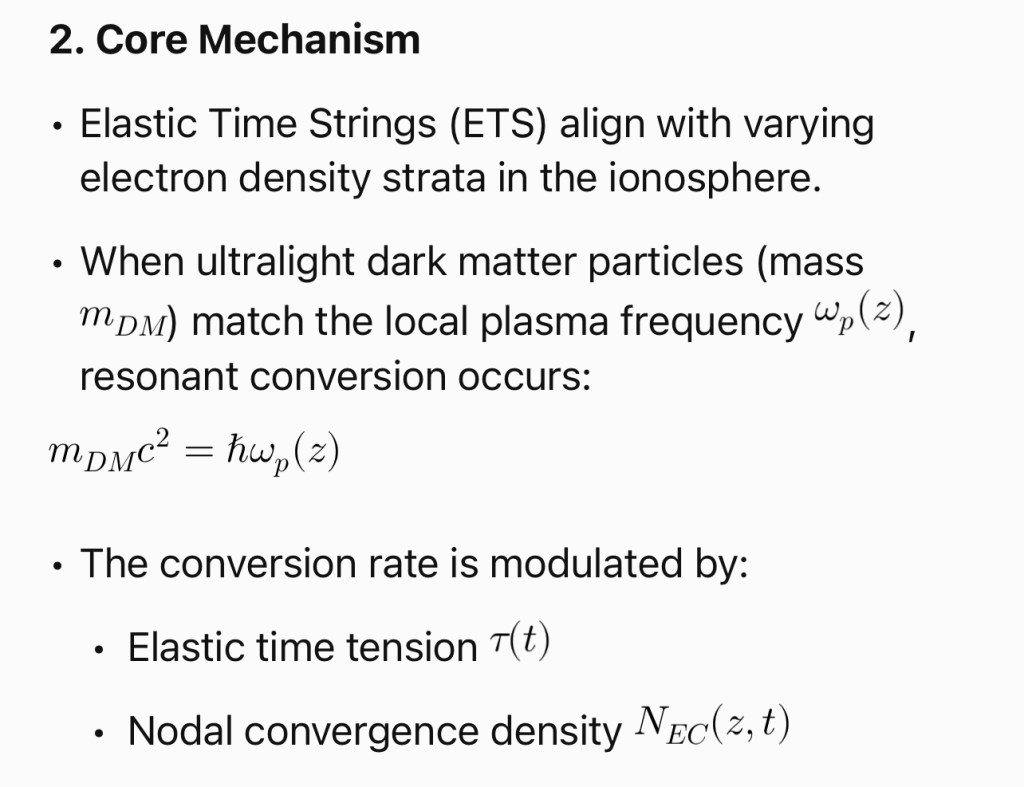
- Elastic Time Strings (ETS) align with varying electron density strata in the ionosphere.
- When ultralight dark matter particles (mass m_{DM}) match the local plasma frequency \omega_p(z), resonant conversion occurs:
m_{DM}c^2 = \hbar \omega_p(z) - The conversion rate is modulated by:
- Elastic time tension \tau(t)
- Nodal convergence density N_{EC}(z,t)
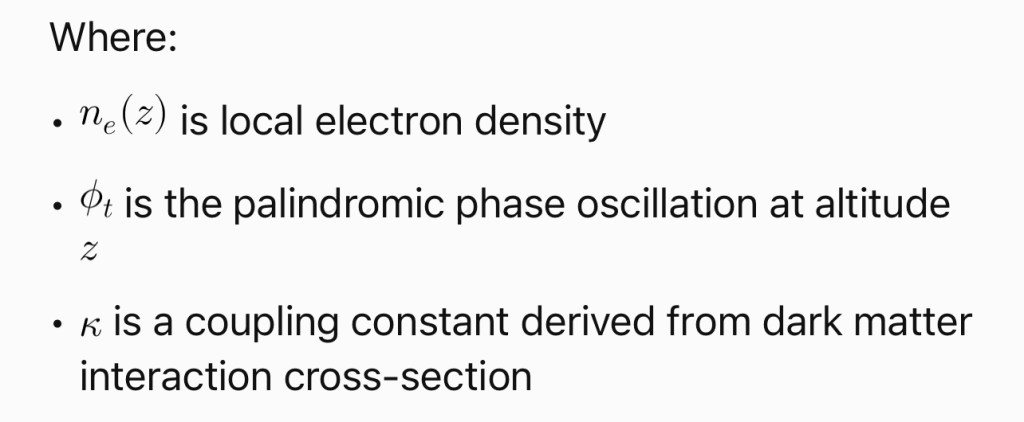
3. Modified Equation Set
4. Detection Parameters
- Use electrically small dipole antennas tuned to 0.1–30 kHz
- Deploy in rural low-noise environments
- Data must be filtered for solar and lightning interference using PEECTS harmonic matching
5. PEECTS-ETC Predictions
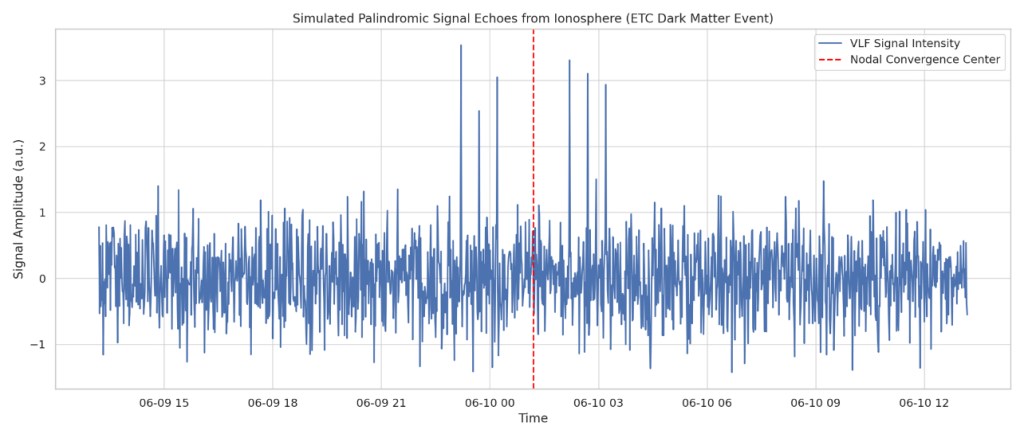
- Photon generation intensity spikes will appear symmetrically in palindromic temporal pairs (forward and retrograde time echoes)
- The spatial distribution of conversions aligns with nighttime high-altitude regions (e.g., equatorial anomaly belts)
6. Experiment Proposal
- Deploy synchronized receivers across latitudinal bands to map ETC phase gradients
- Feed antenna data into WSantaKronos AI for palindromic pattern recognition
- Validate via cross-correlation with geomagnetic and solar wind indices
Conclusion:
This PEECTS-ETC adaptation opens a new, Earth-based avenue to detect ultralight dark matter signatures through spacetime resonance within the ionosphere. Unlike deep-space methods, it leverages well-understood terrestrial plasma dynamics, offering lower-cost and higher-frequency observation capabilities. This extension of PEECTS into atmospheric dark matter detection deepens its relevance in cosmology, spacetime physics, and experimental astrophysics a.s
 A New Theory of the Universe: Palindromic Entangled Elastic Time Strings Theory “