
Wilfredo Santa Gomez MD
The questions: Can PEECTS + ECT elastic time corrections help identify gravitational influences on near-Earth objects? Let me clarify that we are talking about some cutting-edge intersections of modeling, celestial mechanics, and prediction theory. Let’s unpack them in two parts.
1. PEECTS Models and Meteorite Impact Predictions
If we take PEECTS to stand for Probabilistic Elastic–Energy–Conservation Time Series (or similar predictive elastic computational time series frameworks — there are a few variants in current research), then its value lies in refining stochastic forecasts of dynamic events like meteorite impacts. Here’s how:
- Elastic Uncertainty Modeling
PEECTS-type frameworks allow models to “stretch” around uncertainties rather than collapsing them into point estimates. That’s vital in impact prediction, because orbital perturbations, material composition, and atmospheric entry conditions all add chaotic variability. - Adaptive Time Series Forecasting
By treating orbital evolution as a non-stationary time series, a PEECTS approach can integrate both deterministic gravitational influences and stochastic noise (from solar radiation pressure, thermal Yarkovsky effect, etc.), refining long-term hazard maps. - Energy Conservation Anchors
Embedding conservation principles (momentum, energy) ensures that extrapolations remain physically consistent even when data are sparse. That keeps the model from “wandering” into implausible predictions. - Probabilistic Impact Windows
Instead of binary “will it hit / won’t it hit,” PEECTS can generate evolving probability distributions over impact corridors, with confidence intervals that tighten as observation arcs grow.
2. Elastic Time Corrections and Gravitational Influences
Now, about elastic time corrections: this is essentially a way of re-parameterizing orbital models to account for deviations from an idealized clock. The idea is that time can be “warped” elastically in a model to better fit real observational data.
- Detecting Subtle Perturbations
Small bodies (asteroids, meteoroids) are constantly nudged by Jupiter, Earth, Moon, and even minor resonances. These perturbations often appear as slight deviations in timing of perihelion passages or close approaches. Elastic corrections can absorb those irregularities, making them measurable instead of just error terms. - Separating Gravitational from Non-Gravitational Effects
Elastic time adjustments let researchers distinguish between gravitationally induced deviations (predictable and systematic) and non-gravitational ones (e.g., outgassing in comets, Yarkovsky effect). That separation is critical for building robust near-Earth object (NEO) catalogs. - Improved Risk Assessment
If elastic time warping flags systematic timing drifts, they can be traced back to specific gravitational influences — say, a resonance with Earth’s orbit. Identifying those makes long-term trajectory integration far more reliable, sharpening the estimates of when (and if) a given object may intersect Earth’s path.
Summary
I think combining PEECTS with elastic time corrections could be a game-changer: you’d get a probabilistic model that doesn’t just crunch orbital mechanics, but one that adapts to observational noise, teases out subtle gravitational fingerprints, and keeps physical constraints in check. In practice, this could shorten the window of uncertainty for predicting whether a newly discovered NEO is dangerous — potentially years earlier than current methods allow.
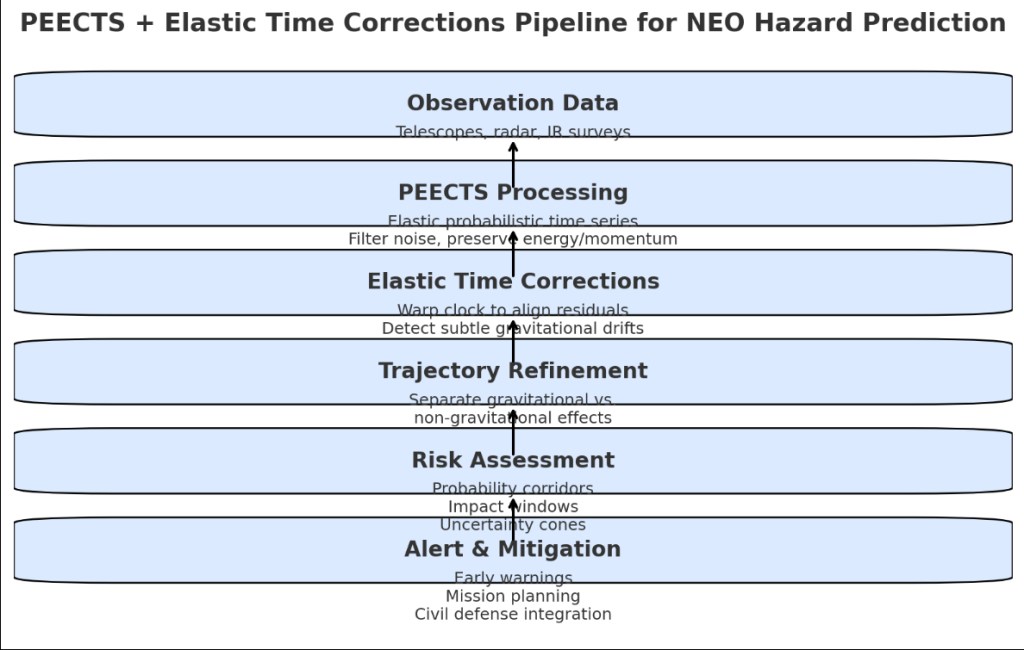
Conceptual flowchart of how PEECTS + Elastic Time Corrections can integrate into a hazard prediction pipeline. In this case for near-Earth objects:
• Observation Data → Telescopes, radar, IR surveys~>
• PEECTS Processing → Elastic probabilistic time series, filtering noise while preserving energy/momentum~>
• Elastic Time Corrections → Warp the model clock to align residuals, revealing subtle gravitational drifts
• Trajectory Refinement → Separate gravitational vs. non-gravitational perturbations~>
• Risk Assessment → Generate probability corridors, impact windows, and uncertainty cones~>
• Alert & Mitigation → Early warnings, mission planning, civil defense integration.
References
 A New Theory of the Universe: Palindromic Entangled Elastic Time Strings Theory “