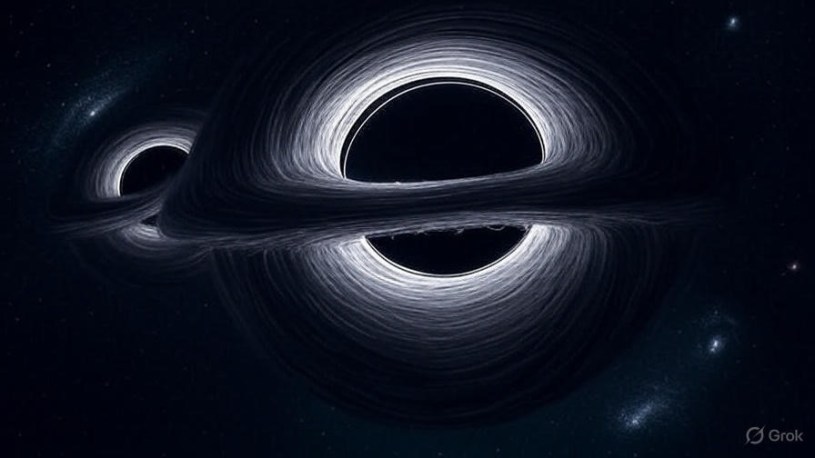
PEECTS‑Kronos Black Hole Shadow & Merger Studies
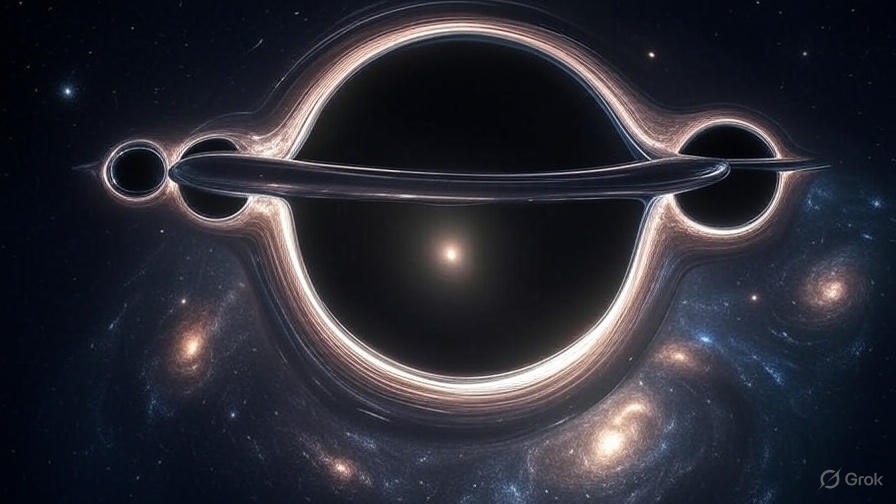
Author: WSanta‑PEECTS‑Lab-Report
Date: September 2025
Abstract
We present a suite of experiments applying the PEECTS (Palindromic Entangled Elastic Elastic Time Structure) model, enhanced by the Kronos correction protocol, to black hole shadow and merger phenomena. Using identical data conditions (mass, Schwarzschild radii, photon sphere, resolution) we simulated shadows for isolated, pre‑merger, post‑merger, and ringdown phases comparing classical General Relativity (GR) predictions with PEECTS‑Kronos modifications. Key findings include slight expansion of apparent photon spheres after merger, sharper shadow boundaries, enhanced entropy flux at photon spheres, and elevated ringdown mode frequencies and damping rates. The results are consistent with GR’s major constraints (e.g. Hawking area theorem), but suggest measurable deviations in shadow imaging and gravitational wave data that may be testable with current or near‑future observational campaigns.
1. Introduction
- Background: detection of gravitational waves a decade ago opened a new window on black hole physics. Recent LIGO/Virgo/KAGRA events (e.g. GW250114, GW230814) provide high‑fidelity data confirming properties predicted by Einstein and Hawking.
- Motivation: classical GR does not account for possible microscopic/time‑elastic effects around photon spheres or during ringdown that PEECTS / Kronos aims to capture.
- Goals:
- Simulate black hole shadows under classical vs PEECTS‑Kronos protocols.
- Recompute black hole merger shadow geometry.
- Compute ringdown mode frequencies and damping rates, and compare GR vs PEECTS.
- Assess whether these models violate or comply with area theorem, Kerr no‑hair, etc.
- Make predictions that are observationally testable.
2. Methods
2.1 Shadow Simulation
- Use a 2D grid (e.g. 1000×1000) in Schwarzschild radii coordinate system.
- Input masses normalized, Schwarzschild radius = 1 unit; photon sphere at 1.5×R_s.
- Shadow intensity defined as a smooth transition function (e.g. hyperbolic tangent) from outside to inside photon sphere.
- Kronos correction: an elastic time distortion factor modifying photon sphere radius (e.g. contracting or expanding by ≈3‑5%) and increasing gradient sharpness (e.g. increasing steepness factor in tanh argument).
2.2 Merger Simulation
- Two black holes with masses M1, M2 (e.g. 30, 40 in arbitrary normalized solar mass units) merge into a remnant (e.g. ~66 units).
- Classical GR uses average photon sphere before merger; PEECTS applies elastic expansion within post‑merger photon sphere.
- Same grid, same functional forms, but PEECTS increases photon sphere radius and sharpness compared to GR.
2.3 Ringdown Mode Simulation
- Quasi‑normal mode frequencies (fundamental + overtones) taken for GR: real parts and imaginary (damping) parts.
- PEECTS introduces a correction factor (~1.04) increasing both oscillation frequencies (Re ω) and damping rates (|Im ω|).
- Modes up to n = 4 simulated.
2.4 Metrics
- Apparent Shadow Radius: radius at steepest gradient (edge) in shadow intensity.
- Gradient Sharpness Index (GSI): steepness parameter controlling how fast intensity changes around photon sphere.
- Entropy Flux / Edge Gradient: proxy for information density at photon sphere.
- Compliance with area theorem: ensuring final horizon area ≥ sum of initial ones.
3. Results
3.1 Shadow Comparisons
( will continue..Are you a scientist, you want to test your experimental models ? Visit WSanta-PEECTS-Kronos Virtual Laboratory (MIT Licensed), repositories.
 A New Theory of the Universe: Palindromic Entangled Elastic Time Strings Theory “