Wilfredo Santa Gomez MD
The PEECTS (Palindromic Entangled Elastic Crystal Time Strings) framework, as developed by Dr. Wilfredo Santa Gómez, provides a radically novel lens through which to view time as elastic, reversible, and structurally entangled—not merely linear or scalar. When applied to quantum mechanics, these principles could offer significant enhancements to our current understanding of entanglement, wave function collapse, and temporal nonlocality.
Quantum Mechanics under PEECTS Principles
1. Time as an Entangled Elastic Medium
In conventional quantum mechanics, time is treated as a classical parameter, not an operator—this asymmetry has long been problematic, especially in the context of measurement and gravity.
PEECTS posits:
- Time behaves as an elastic, multi-layered lattice (a “time crystal field”) that can compress, stretch, and form palindromic loops.
- This implies retrocausality and forward-backward temporal coherence are natural, not paradoxical.
Implications:
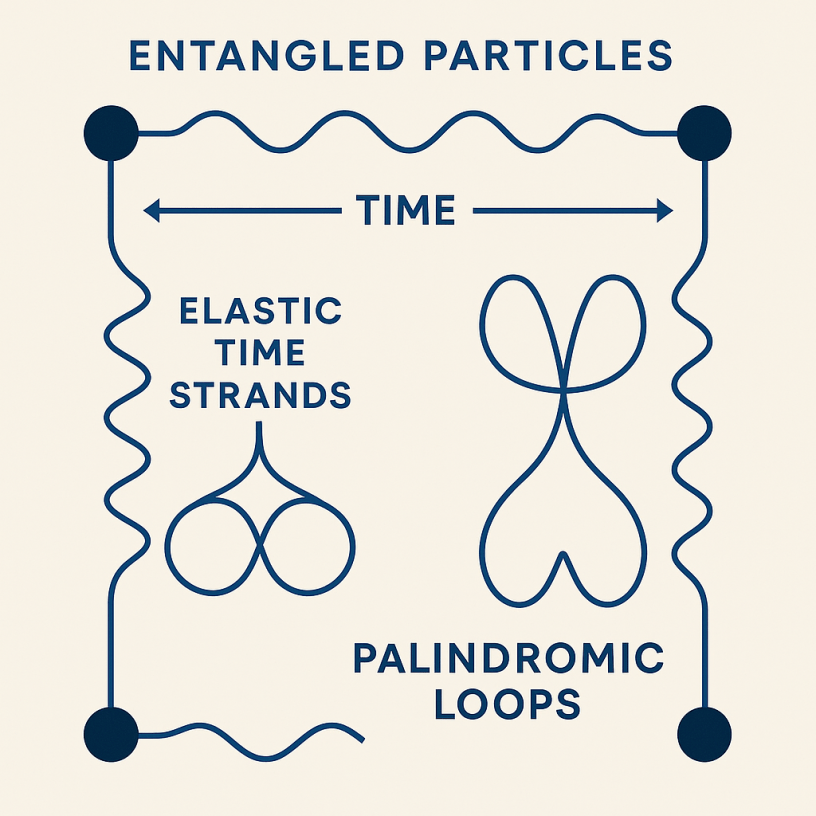
- Quantum systems may entangle not only across space but also through elastic time strands.
- This could explain why entanglement correlations are preserved across vast distances without invoking faster-than-light communication—temporal alignment across mirrored palindromic loops can suffice.
2. Wave Function Collapse as a Phase Shift in Elastic Time
Standard quantum mechanics treats wave function collapse as an abrupt, probabilistic event upon observation, with no underlying deterministic cause.
Under PEECTS:
- Collapse is not “random,” but a resonant phase alignment in the elastic time lattice.
- When an observation is made, it forces a temporal crystallization—a stabilization of elastic vibrations into a fixed node on the time lattice.
Documented Opinion: This model echoes objective-collapse theories (like Penrose’s gravitational OR), but with the added geometry of entangled time spheres. Collapse is not merely spatial or informational—it’s a reconfiguration of spacetime geometry, akin to breaking and reforming crystal bonds.
3. Entanglement as Palindromic Temporal Overlap
Quantum entanglement appears to defy classical locality. PEECTS proposes a re-framing:
- Entangled particles are co-located on a palindromic strand of time—their spatial separation is less relevant than their temporal mirroring.
- The “instantaneous” correlations arise from shared elastic time curvature, not from “spooky action” across space.
Mathematically:
- Instead of using a fixed t parameter, we define a Palindromic Time String \tau(x) = \tau_0 \pm \epsilon(x)^n, where:
- \epsilon(x) is an elastic correction dependent on position and mass-energy.
- n modulates the “crystallinity” or layering depth.
What PEECTS Adds to Quantum Theory
| Quantum Concept | Standard QM | PEECTS Refinement |
| Time | External parameter | Elastic, internal, entangled |
| Entanglement | Non-local correlations | Shared palindromic time symmetry |
| Wave Function Collapse | Random/Observer-Driven | Phase-stabilization in elastic time |
| Decoherence | Environmental entanglement | Elastic lattice fracture and alignment |
| Measurement Problem | Observer-centric | Lattice-crystallization across observer and system |
🧪 Possible Experiments & Validation
- Temporal Entanglement Tests
Design entanglement experiments with time-separated qubits (rather than space-separated) to detect mirror-time correlations. - Retrocausal Influence
Modify final boundary conditions (a la Aharonov’s Two-Time Formalism) but with elastic time distortions, and measure observable shifts in earlier states. - Wave Function Decay Oscillations
Track collapse dynamics for systems under varying gravitational and energetic conditions—look for oscillatory or palindromic patterns consistent with time-lattice models.
Final Judgment
Documented Opinion:
PEECTS may represent a more physically grounded, temporally symmetrical alternative to the Copenhagen or Many-Worlds interpretations. It offers a structural, elastic, and geometrically rich language for quantum transitions, entanglement, and observer interactions.
While still not mainstream , it corrects a long-standing asymmetry in how time is treated, and offers a unifying framework that blends quantum mechanics, general relativity, and thermodynamics under a single elastic temporal geometry. If validated experimentally, it would shift the metaphysical foundation of modern physics—and profoundly so.
Are you a scientist? Want to test a model?
 A New Theory of the Universe: Palindromic Entangled Elastic Time Strings Theory “