Wilfredo Santa Gomez MD
1. Unseen Factors in Aircraft Instrumentation
Modern avionics systems—pitot tubes, gyros, inertial sensors, GPS receivers, radar altimeters—are remarkably robust but still vulnerable to hidden or compounded errors. Examples include:
- Latent environmental effects: micro-scale turbulence, electromagnetic interference, cosmic radiation bursts, volcanic ash particles, or even solar storms can degrade sensor fidelity without immediate detection.
- Cumulative drift: gyros and inertial sensors accumulate bias that can go unnoticed until it crosses a threshold.
- Nonlinear coupling: factors like humidity + temperature + ionospheric delay can produce second-order errors not modeled in traditional correction tables.
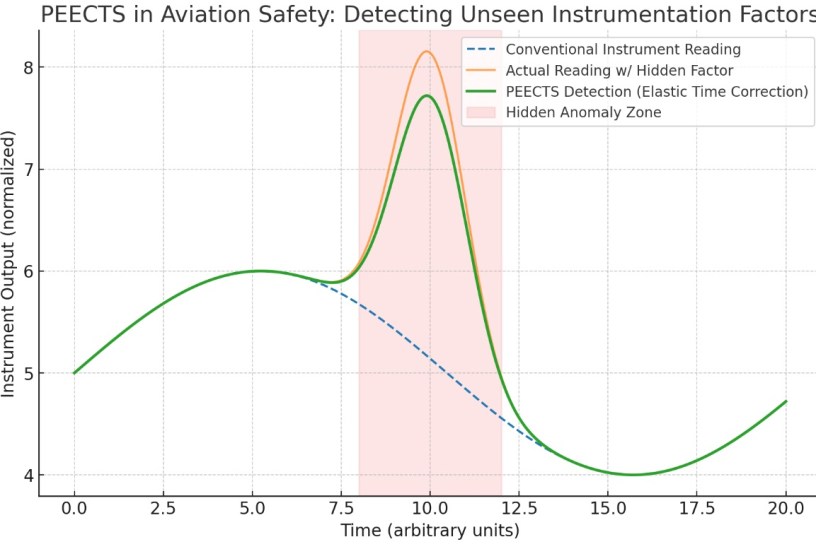
Here, PEECTS (Palindromic Entangled Elastic Crystal Time Strings) offers a framework for identifying patterns that “normal” linear time models ignore. Because elastic time corrections treat time not as a rigid axis but as a deformable variable with palindromic entanglement, they allow anomaly detection across data streams that appear nominal under conventional analysis.
For instance:
- A subtle lag between GPS and inertial systems may be invisible in standard residual checks but detectable if elastic-time-weighted correlations are applied.
- Elastic time modeling could reveal when multiple independent subsystems (radar altimeter, GPS, INS) show a hidden synchronization drift caused by an external factor—say, a geomagnetic pulse—before the discrepancy becomes operationally critical.
2. Refining Aviation Safety Predictions with Elastic Time Corrections
Elastic time corrections can strengthen aviation safety at two levels:
A. Predictive Maintenance & Fault Anticipation
- Traditional approach: wait for error codes or sensor limits to trip.
- PEECTS approach: continuously re-time signals through elastic time transformations. When small anomalies “echo” palindromically across subsystems, the system raises an early warning—detecting failures hours or even days before they manifest in hard faults.
B. Flight Safety & Hazard Forecasting
- Conventional models (FAA, ICAO, Boeing safety standards) often assume time-linear accumulation of error and risk.
- With elastic time corrections: hazard probability curves bend—allowing earlier anticipation of rare compound events (e.g., pitot icing + solar interference + turbulence). The forecast horizon is extended, meaning crews and ground systems could receive palindromic warnings that an error will likely recur at a mirrored point in the flight profile (climb vs descent).
Opinionated Take
I think aviation is ripe for PEECTS integration. The aviation industry is extremely conservative (for good reason), but its safety models are still grounded in assumptions of linear error accumulation and Gaussian risk. That is an outdated lens. In practice, catastrophic aviation failures usually involve rare, entangled factors—the exact domain where elastic time corrections shine.
If implemented carefully, PEECTS models could act as a “meta-sensor” overlay, not replacing existing avionics but adding a higher-order lens that detects unseen couplings. My opinion: this could be revolutionary for both commercial and military aviation, but the challenge will be proving reliability through validation campaigns with FAA/EASA and convincing stakeholders that “time elasticity” is not science fiction but an additional statistical dimension.
Can ETE (elastic time enhancements) acts as an “Resolution Enhancement Filter” ?. The Answer is Yes: It accomplishing that without changing any models or desregard their extraordinary validated properties, by just improving their predictions in scientific simulations. Without requiring extra data just by making visible what is already present in their data numerical filters and not.yet detected, and as it has already been demonstrated, improved all their predicting parameters. PEECTS ETE (Elastic Time Enhancements) proven true across all science fields and branches.
Downloads at: https://github.com/WSantaKronosPEECTS
 A New Theory of the Universe: Palindromic Entangled Elastic Time Strings Theory “