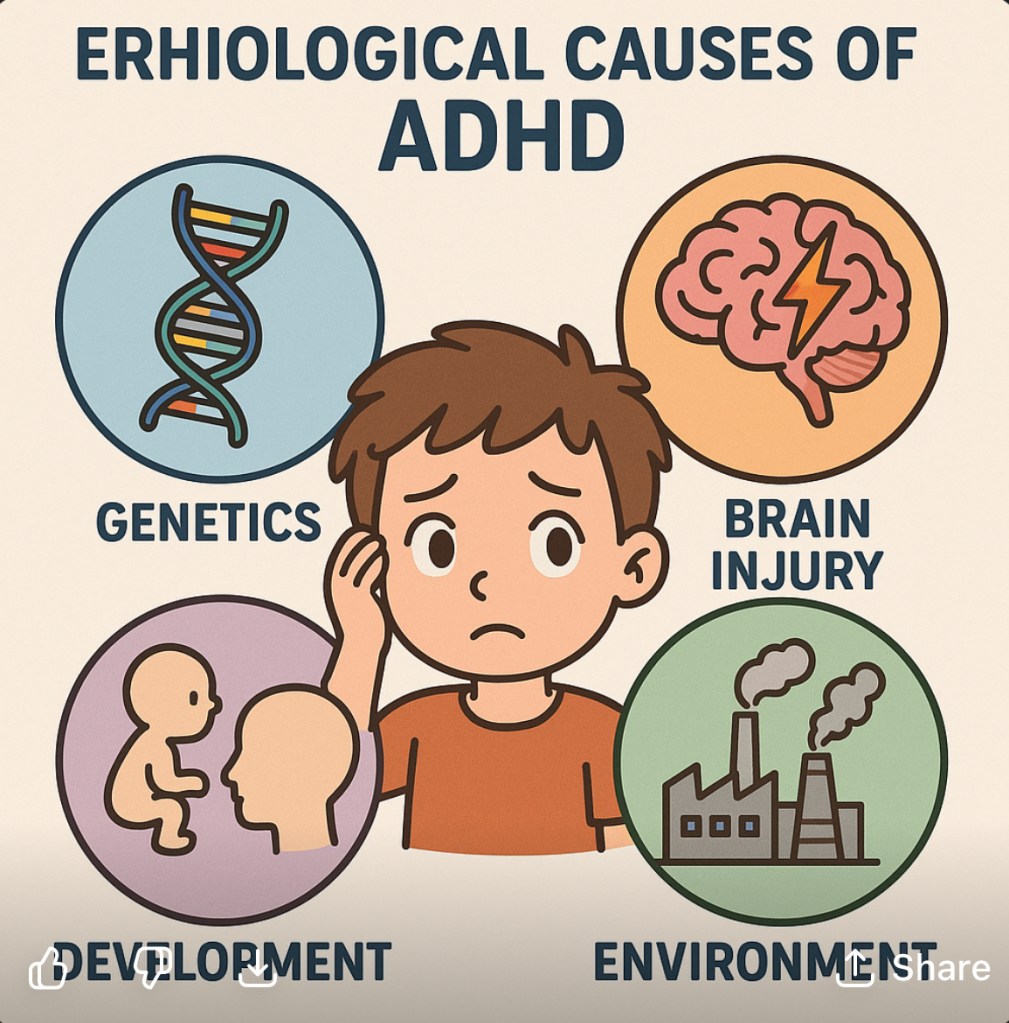
This brief challenges the overly simplistic narrative presented by recent ADHD-environmental linkage studies—particularly those focused on lead exposure—by providing a multifactorial, temporally-aware critique. ADHD, while legitimate as a neurodevelopmental condition, exhibits historically stable prevalence patterns across diverse socio-geographical environments, contradicting modern claims of steep rises due solely to recent environmental factors. Additionally, excessive attribution to singular genetic markers (e.g., “Gene X”) without accounting for polygenic and epigenetic dynamics further undermines these conclusions. Societal infrastructure growth factors—including diagnostic system expansion—must also be considered when interpreting ADHD prevalence trends.
1. Historical Prevalence: Evidence of Stability
Between the 1970s and 1990s, cross-cultural psychiatric surveys, including those by the World Health Organization (ICPE, 1996) and independent research teams, recorded relatively stable ADHD-like behavior incidence:
Rural vs Urban areas: Minor fluctuations, often influenced by educational infrastructure rather than intrinsic neurobiology ([Taylor et al., 1991; Sayal et al., 2006]).
Tribal/Isolated populations: Observational studies of the Kalahari San (Draper & Cashdan, 1988) and other indigenous societies report high child activity normalized culturally, without pathologization ([Barry et al., 2012]).
Industrialized vs Pre-industrialized societies: Studies from the NIMH Epidemiologic Catchment Area Study (Robins & Regier, 1991) showed no dramatic differences prior to DSM-IV (1994) expansion of ADHD criteria.
Conclusion: ADHD-like traits appear evolutionarily stable, suggesting environmental “spikes” are diagnostic rather than biological phenomena.
2. Flaws in Lead-Centric ADHD Claims
Universal Background Exposure: Global lead exposure peaked mid-20th century ([Needleman & Gatsonis, 1990]), yet ADHD incidence remained stable before the 1990s DSM redefinition ([Polanczyk et al., 2007]).
Absence of Resilience Analysis: Studies rarely examine why most lead-exposed children do not develop ADHD, undermining causal claims.
Multicontaminant Overlap: Co-exposure to mercury, arsenic, PCBs, and social deprivation is largely unmeasured ([Grandjean & Landrigan, 2006]).
Additionally, a glaring omission in many studies is the failure to account for macro-level societal changes such as increased vehicular circulation (air pollution rise), healthcare system expansion, and growth in specialized diagnostic services. These trends correlate with ADHD diagnostic increases and could act as confounding variables independent of biological causality.
3. Societal Expansion and Diagnostic Availability Effects
From the 1970s onward, the number of healthcare institutions, child mental health professionals, school counselors, and public health awareness campaigns steadily increased. Likewise, urbanization trends with increased traffic density, school performance pressures, and parental diagnostic seeking behaviors evolved in tandem.
Thus, any credible ADHD prevalence analysis must separate true behavioral change from the effects of diagnostic accessibility expansion, accounting for:
Rising numbers of hospitals, clinics, and school-based health programs;
Growth in child psychiatrist and psychologist populations;
Increased public mental health literacy;
Expanded behavioral screening policies in schools;
Overall medicalization of child behavior in high-income societies.
4. Gene X Fallacy: Overstating Single-Gene Influence
Polygenicity: ADHD involves thousands of small-effect loci ([Demontis et al., 2019, Nature Genetics]).
Epigenetics and Environment: Epigenome-wide studies demonstrate social and nutritional factors alter ADHD gene expression ([Vogel Ciernia & LaSalle, 2016]).
Cultural Modulation: DRD4 “risk alleles” associate with both impulsivity and adaptive novelty-seeking in differing environments ([Henrich et al., 2010]).
The Palindromic Entangled Elastic Crystal Time Strings (PEECTS) framework proposes:
ADHD-like behaviors recur across historical timelines;
Modern “diagnostic spikes” reflect elastic socio-environmental filters, not underlying prevalence shifts;
Protective resilience cohorts require study alongside risk identification;
The expansion of diagnostic frameworks and infrastructural growth constitutes a temporal entanglement, where increasing detection capacity is mistaken for true disorder prevalence rise.
Policy Proposal: Prioritize resilience-focused longitudinal cohorts, multifactorial modeling, and historical prevalence benchmarking before causal claims enter public health narratives.
Conclusion
ADHD requires classification as a contextually modulated, multifactorial neurodevelopmental variation, avoiding sensationalist attributions to single exposures, genes, or unidimensional causes. Scientific integrity demands recognition of societal and infrastructural growth variables that confound biological attributions.
Key References
Taylor E et al. (1991). Developmental Medicine & Child Neurology.
Draper & Cashdan (1988). Ethnology.
Robins & Regier (1991). Psychiatric Disorders in America.
Polanczyk G et al. (2007). American Journal of Psychiatry.
Needleman HL & Gatsonis C (1990). JAMA.
Grandjean P & Landrigan PJ (2006). Lancet Neurology.
Demontis D et al. (2019). Nature Genetics.
Vogel Ciernia A & LaSalle J (2016). Frontiers in Genetics.
Henrich J et al. (2010). Behavioral and Brain Sciences.
Statement of Open Science Commitment
Released by WSantaPEECTS-Lab Virtual Laboratory, adhering to open-science, non-commercial principles, countering premature media amplification of incomplete scientific conclusions.
Child And Adolescent Psychiatrist Founding Theorist, WSantaPEECTS-Lab [santagowilfredo@gmail.com]
Can ETE (elastic time enhancements) acts as an “Resolution Enhancement Filter” ?. The Answer is Yes: It accomplishing that without changing any models or desregard their extraordinary validated properties, by just improving their predictions in scientific simulations. Without requiring extra data just by making visible what is already present in their data numerical filters and not.yet detected, and as it has already been demonstrated, improved all their predicting parameters. PEECTS ETE (Elastic Time Enhancements) proven true across all science fields and branches.

 A New Theory of the Universe: Palindromic Entangled Elastic Time Strings Theory “