Wilfredo Santa Gómez MD
PEECTS-ETC Neural Bypass Model for Intractable Migraine: Research Proposal
Title:
Chrono-Neural Disruption of Intractable Migraine via PEECTS Elastic Time Correction (ETC) Framework: A Palindromic Time-Loop Bypass Model
Abstract:
Chronic intractable migraines remain a debilitating neurological condition resistant to pharmacological and interventional treatments. This paper proposes a novel, non-invasive theoretical model derived from the Palindromic Entangled Elastic Crystal Time Strings (PEECTS) framework. Utilizing Elastic Time Correction (ETC), we introduce the concept of chrono-neural bypassing to disrupt pathological migraine loops by targeting the temporal-spatial energy imbalances sustaining chronic migraine cycles.
Background:
While therapies like CGRP inhibitors, neuromodulation (e.g., Vagus Nerve Stimulation – VNS), and repetitive Transcranial Magnetic Stimulation (rTMS) offer relief to subsets of migraine sufferers, intractable migraine remains poorly addressed. These treatments typically overlook the temporal feedback loops and palindromic reactivation patterns that sustain chronic migraines. PEECTS-ETC introduces an innovative perspective by targeting these underlying time-space dynamics through elastic field modulation and chrono-neural bypass techniques.
Introduction:
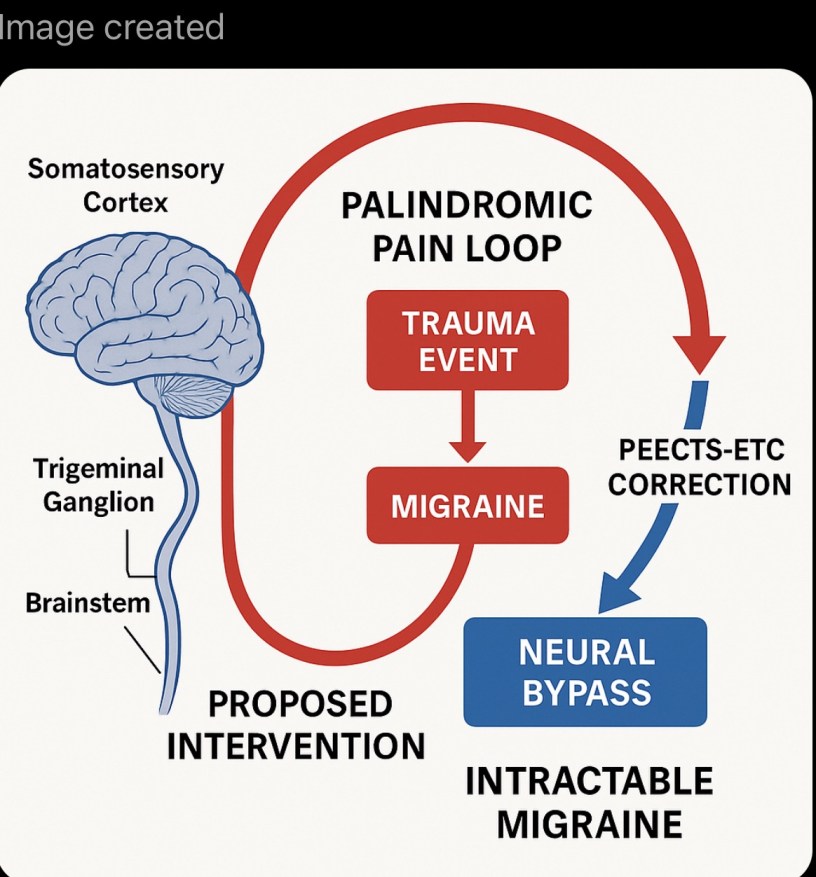
Current migraine therapies primarily target symptomatic relief or singular biochemical pathways. PEECTS proposes a multi-layered approach: neural pain loops are sustained not only by biochemical and electrical activity but by elastic entanglement in time, forming self-reinforcing pathological cycles. The hypothesis is that migraines are sustained by palindromic feedback loops at both neural and temporal levels, with key activation zones such as the trigeminal ganglion, periaqueductal gray (PAG), and hypothalamus.
Objectives:
- To demonstrate theoretical feasibility of time-field modulation in chronic migraine.
- To model retro-causal energy dynamics in the pain feedback loop.
- To propose a chrono-elastic bypass framework applicable via non-invasive neuromodulation techniques.
Methodological Framework:
1. Time-Loop Palindromic Encoding:
Identify cyclical trauma inflection points responsible for migraine loop formation using patient history and symptom chronology.
2. Elastic Correction Modulation:
Application of theoretical low-frequency, non-invasive elastic time-field pulses designed to relax temporal tension within hyperactivated pain circuits.
3. Chrono-Neural Bypass Activation:
Bypass the primary trigeminal-thalamic-cortical feedback loop by targeting alternative neural pathways using chronoelastic modulation protocols.
4. Neuroanatomical Focus:
- Trigeminal Ganglion
- Periaqueductal Gray (PAG)
- Hypothalamus (arcuate nucleus)
- Thalamus-Somatosensory Cortex Loop
- Prefrontal Cortical Synchronization Nodes
- 5. Theoretical Model Schemati
- Trauma Encoding → Time Loop Formation → Chronic Pain Loop Fixation
- ↓ ETC Modulation ↓
- Elastic Tension Relaxation → Neural Loop Bypass →
- 6. Chrono-Neural Feedback Algorithm (Outline):
- Initialize Patient Baseline Mapping;
- Identify Dominant Trauma Nodes;
- Calculate Temporal Elastic Strain Index (TESI);
- Apply ETC Pulses Based on TESI Dynamics;
- Monitor Chrono-Neural Resonance Feedback;
- Adjust Bypass Modulation Parameters;
- Evaluate Symptomatic Relief Cycles.
- PEECTS-ETC Neural Bypass Model for Intractable Migraine: Research Proposal
- Title:
- Chrono-Neural Disruption of Intractable Migraine via PEECTS Elastic Time Correction (ETC) Framework: A Palindromic Time-Loop Bypass Model
- Abstract:
- Chronic intractable migraines remain a debilitating neurological condition resistant to pharmacological and interventional treatments. This paper proposes a novel, non-invasive theoretical model derived from the Palindromic Entangled Elastic Crystal Time Strings (PEECTS) framework. Utilizing Elastic Time Correction (ETC), we introduce the concept of chrono-neural bypassing to disrupt pathological migraine loops by targeting the temporal-spatial energy imbalances sustaining chronic migraine cycles.
- Background:
- While therapies like CGRP inhibitors, neuromodulation (e.g., Vagus Nerve Stimulation – VNS), and repetitive Transcranial Magnetic Stimulation (rTMS) offer relief to subsets of migraine sufferers, intractable migraine remains poorly addressed. These treatments typically overlook the temporal feedback loops and palindromic reactivation patterns that sustain chronic migraines. PEECTS-ETC introduces an innovative perspective by targeting these underlying time-space dynamics through elastic field modulation and chrono-neural bypass techniques.
- Introduction:
- Current migraine therapies primarily target symptomatic relief or singular biochemical pathways. PEECTS proposes a multi-layered approach: neural pain loops are sustained not only by biochemical and electrical activity but by elastic entanglement in time, forming self-reinforcing pathological cycles. The hypothesis is that migraines are sustained by palindromic feedback loops at both neural and temporal levels, with key activation zones such as the trigeminal ganglion, periaqueductal gray (PAG), and hypothalamus.
- Objectives:
- To demonstrate theoretical feasibility of time-field modulation in chronic migraine.
- To model retro-causal energy dynamics in the pain feedback loop.
- To propose a chrono-elastic bypass framework applicable via non-invasive neuromodulation techniques.
- Methodological Framework:
- 1. Time-Loop Palindromic Encoding:
- Identify cyclical trauma inflection points responsible for migraine loop formation using patient history and symptom chronology.
- 2. Elastic Correction Modulation:
- Application of theoretical low-frequency, non-invasive elastic time-field pulses designed to relax temporal tension within hyperactivated pain circuits.
- 3. Chrono-Neural Bypass Activation:
- Bypass the primary trigeminal-thalamic-cortical feedback loop by targeting alternative neural pathways using chronoelastic modulation protocols.
- 4. Neuroanatomical Focus:
- Trigeminal Ganglion
- Periaqueductal Gray (PAG)
- Hypothalamus (arcuate nucleus)
- Thalamus-Somatosensory Cortex Loop
- Prefrontal Cortical Synchronization Nodes
- 5. Theoretical Model Schematic:
- Trauma Encoding → Time Loop Formation → Chronic Pain Loop Fixation
- ↓ ETC Modulation ↓
- Elastic Tension Relaxation → Neural Loop Bypass → Symptom Reduction
- 6. Chrono-Neural Feedback Algorithm (Outline):
- Initialize Patient Baseline Mapping;
- Identify Dominant Trauma Nodes;
- Calculate Temporal Elastic Strain Index (TESI);
- Apply ETC Pulses Based on TESI Dynamics;
- Monitor Chrono-Neural Resonance Feedback;
- Adjust Bypass Modulation Parameters;
- Evaluate Symptomatic Relief Cycles.
- Expected Results:
- Disruption of pathological palindromic loops in migraine patients.
- Improved temporal homeostasis in pain-associated neural regions.
- Decrease in frequency and severity of intractable migraine episodes, with a target of ≥50% reduction in attack frequency and ≥40% reduction in intensity within three months of protocol application.
- Conclusion:
- The PEECTS ETC model offers a non-invasive, time-modulated neural bypass alternative targeting the root energetic patterns of intractable migraine. Future clinical pilot studies are proposed to validate computational predictions and evaluate patient outcomes.
- Keywords:
- PEECTS, Elastic Time Correction, Chrono-Neural Bypass, Intractable Migraine, Palindromic Feedback Loops, Temporal Neuromodulation, Pain Cycle Disruption.
Can ETE (elastic time enhancements) acts as an “Resolution Enhancement Filter” ?. The Answer is Yes: It accomplishing that without changing any models or desregard their extraordinary validated properties, by just improving their predictions in scientific simulations. Without requiring extra data just by making visible what is already present in their data numerical filters and not.yet detected, and as it has already been demonstrated, improved all their predicting parameters. PEECTS ETE (Elastic Time Enhancements) proven true across all science fields and branches.
Downloads at: https://github.com/WSantaKronosPEECTS
 A New Theory of the Universe: Palindromic Entangled Elastic Time Strings Theory “