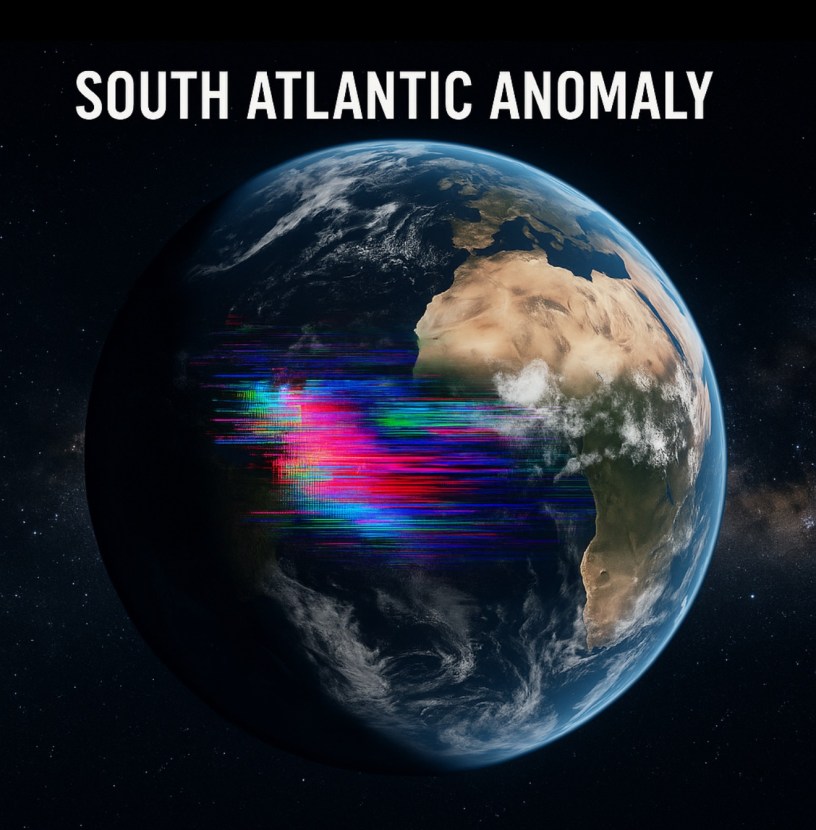
Here’s a breakdown of the NASA article—and my take on it:
What’s Happening?
Why It Matters?
- Satellite Vulnerability
Satellites and spacecraft passing through the SAA are more likely to experience single event upsets (temporary data or system glitches), even permanent damage. Most missions (including the ISS and NASA’s ICON spacecraft) precautionarily disable non-essential systems during transit . - Deep-Earth Insight
The anomaly results from complex geodynamo activity: molten iron flows in Earth’s outer core, combined with deep mantle structures like the African LLSVP, disrupt the field locally . - Magnetic Evolution & Forecasts
Instruments like ESA’s Swarm and archival missions like SAMPEX have tracked the SAA drifting northwest and gradually splitting into two weaker lobes . Models indicate this split is ongoing and warrants continued monitoring .
What’s Good
- Proactive Sat Safety: NASA’s diligent monitoring ensures satellites avoid malfunction.
- Scientific Value: The SAA offers a rare window into Earth’s inner workings—valuable for both geophysics and space weather research.
Concerns
- Growing Complexity: As the anomaly drifts and divides, its unpredictable behavior could increasingly challenge space missions.
- Is It a Prelude? While unlikely, some speculate it may be an early sign of a broader magnetic field shift. But historical data (as far back as ~11 million years) suggests it’s a recurring, not necessarily catastrophic, phenomenon .
Conclusion
While the South Atlantic Anomaly isn’t a threat to life on Earth, it’s absolutely significant for satellites and geomagnetic science. The fact that it’s splitting adds both technical challenges and unique research opportunities—especially to understand the turbulent heartbeat of our planet’s core. Personally, I find it exciting that such a “dent” can reveal so much about Earth’s hidden dynamics. Still, mission planners will need to stay vigilant as this anomaly continues to evolve..
 A New Theory of the Universe: Palindromic Entangled Elastic Time Strings Theory “