PEECTS Miniature Fusion
Wilfredo Santa Gomez

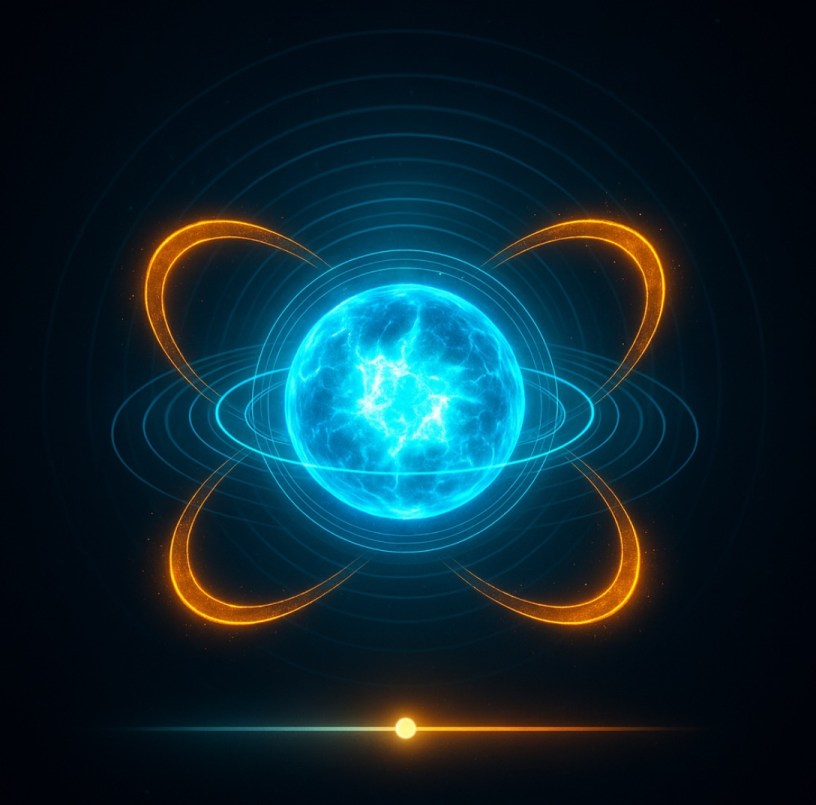
Figure: A high-resolution visualization of a miniature fusion sun stabilized by PEECTS’s Elastic Time Correction (ETC) and palindromic time symmetry. A blue-white plasma core is encircled by cyan magnetic/sensor rings and golden palindromic time loops, with a subtle glowing timeline bar at the bottom indicating the projected stability duration.
Blue-White Plasma Fusion Core
At the center is the fusion core, a small “artificial sun” of hot plasma glowing blue-white. This represents a self-contained fusion reaction – essentially a miniature star. Intense magnetic confinement is implied, as in a tokamak-style reactor where powerful fields hold the plasma in place . The core’s coloration (white at the very center, grading to electric blue at the edges) conveys extreme temperature and energy density. This plasma torus/sphere provides the energy source, with the PEECTS lab simulation
leveraging Elastic Time Correction to keep it stable. In PEECTS theory, time elasticity can influence mass-energy dynamics – effectively slowing down time in the core region to prevent disruptive instabilities. The core thus appears suspended in time, shining steadily instead of flaring out.
Cyan Magnetic Containment & Sensor Rings
Surrounding the core are several cyan rings, symbolizing both the magnetic containment fields and the sensor overlays monitoring the reaction. These concentric rings are reminiscent of the magnetic coil structures that confine fusion plasmas (often called magnetic “donuts” or toroids) . In the image, they also serve as data overlay guides – imaginary instrument readouts of the temporal and spatial distortions around the core. According to PEECTS, any intense energy concentration would stretch or compress local time (“elastic” time). The rings, drawn with a neon cyan glow, mark equal intervals of radial distance and act like contour lines for time dilation or other field effects. Their evenly spaced, circular form highlights that time distortions are being actively measured and kept symmetrical. Minor deviations or wobbles in these rings (if any) would indicate fluctuations in the elastic time field, but here they remain uniformly spaced – a sign of a controlled, stable containment under ETC adjustment. (Notably, PEECTS suggests using precise instruments like atomic clocks or LIGO-like detectors to detect such time elasticity, which these rings conceptually represent in the visual.)
Golden Palindromic Time Symmetry Loops
Encircling the core, looping above and below it, are golden arcs shaped into a symmetric, figure-eight-like path. These arcs depict palindromic time loops – a hallmark of PEECTS theory where time has a mirrored, bidirectional symmetry. The two loops (one on each side of the core) are perfectly symmetric “time echoes” of each other (hence the palindromic, or mirror-reflected, nature). This symbolizes that temporal processes in this fusion experiment are happening in a time-symmetric way: for every forward-time evolution in the system, a corresponding backward-time echo is maintained, keeping the system in balance. In the PEECTS framework, such palindromic entangled states mean the timeline of the reaction is reversible or self-cancelling, preventing entropy increase in one direction. The golden color of these arcs signifies their relation to time (often metaphorically “golden threads” of time). They emanate from the core and loop around it, visually reinforcing that the fusion core’s energy is entangled with its own past and future state. In essence, the reactor runs with time running in a loop – a closed timelike curve ensuring stability. The loops meet at the core, illustrating the CPT-like symmetry (akin to charge-parity-time reversal symmetry) that inspired Dr. Santa’s palindromic time hypothesis. By having these two arcs feed back into the core from opposite sides, the image conveys that the system’s timeline is self-correcting: disturbances forward in time are balanced by inverse disturbances backward in time, keeping the core in a steady state.
Elastic Time Distortion Indicator & Timeline Slider
At the bottom of the visualization is a soft timeline slider – a horizontal glowing bar (in subtle gold/white) that indicates the projected stability duration of the miniature sun. This UI-like element in the lab simulation report shows how long the fusion core can remain stable under current conditions. The bar is partially filled, suggesting, for example, that the reactor is perhaps 60% through its stable confinement period before some adjustment or cooldown is needed. This slider’s coloration ties it to the time loops (golden hue), implying that it’s measuring time-related stability. In a real PEECTS lab readout, this might correspond to an Elastic Time Correction factor or a countdown until temporal strain needs to be reset. The “elastic” nature of time in PEECTS means the system can prolong stability by stretching the time experienced by the core, and the slider visualizes this extension. It glows softly rather than sharply, so as not to distract from the core; this softness also symbolizes uncertainty and flexibility – the duration isn’t a hard cutoff but an adjustable parameter via ETC. Small markings or a knob on the slider denote the current time point, much like a progress indicator. Together with the rings and loops, this timeline bar makes the image feel like a snapshot from a futuristic control interface: it blends scientific data with visualization. It reminds the viewer that time is an active variable being controlled in this experiment, and serves as a key to interpreting the palindromic loops (the slider’s progress correlates with how “in sync” the forward and backward time loops are).
Scientific and Symbolic Integration
Overall, the image balances scientific realism with symbolic representation. The color scheme itself is meaningful: the blue-white core suggests high-temperature plasma and also evokes the hottest stars (blue-white giants), anchoring the fusion concept in reality. Cyan rings are often used in sci-fi interfaces to denote energy fields or sensors, here indicating both the magnetic field lines and the measurement grids for time-space distortions. The golden time loops contrast against the cooler colors, highlighting their conceptual importance – gold often symbolizes value and here the precious symmetry of time that PEECTS theory leverages. By using palindromic (mirror-image) loops, the image directly nods to the Palindromic Entangled Elastic Time Strings theory’s core idea that physical processes can be time-reflected without contradiction. The inclusion of a timeline slider grounds the scene in a lab setting – implying that this is part of a controlled simulation or experiment readout, not a naturally occurring phenomenon. It conveys that scientists (or the system AI) are monitoring and possibly adjusting the temporal settings in real-time.
Finally, this PEECTS miniature sun visualization serves as an illustrative fusion of art and science: it takes theoretical concepts (time elasticity, palindromic symmetry, entangled time strings) and embeds them in a concrete scenario of a fusion reactor. By doing so, it provides an intuitive way to grasp how PEECTS might stabilize something as volatile as a miniature star – namely, by looping time on itself and carefully monitoring the temporal field, one can contain and prolong the fusion burn beyond ordinary limits. This image could indeed be a figure in a PEECTS Lab report or presentation, helping audiences imagine what controlling time around a fusion plasma might look like. The synergy of the visual elements echoes the interdisciplinary nature of PEECTS (drawing on relativity, quantum mechanics, and cosmology), making the complex theory accessible through a single, powerful graphic.
Sources: The concepts and theory referenced are drawn from Dr. Wilfredo Santa Gómez’s PEECTS publications and related discussions on time elasticity and symmetry. The fusion reactor analogy is informed by standard magnetic confinement fusion research , connecting the visual’s scientific basis to real-world physics.
 A New Theory of the Universe: Palindromic Entangled Elastic Time Strings Theory “