Author: Wilfredo Santa Gomez MD
WSantaKronos Virtual Research Laboratory
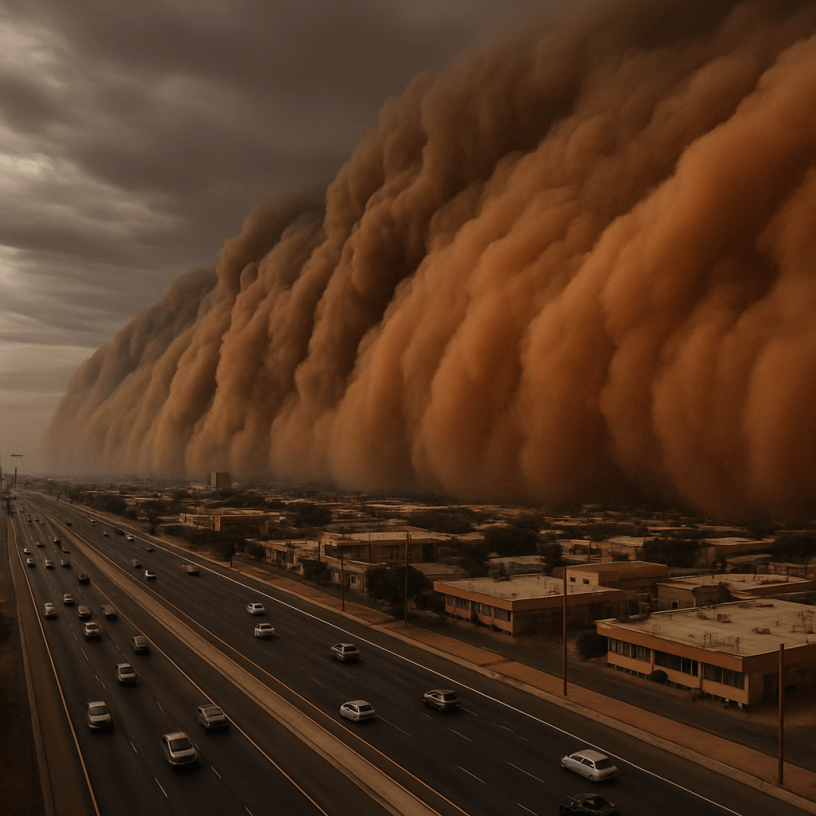
The PEECTS framework can offer new predictive insights into phenomena like haboobs (intense dust storms) by modeling the elastic entanglement of time, air mass density shifts, and microburst triggers across environmental layers. Here’s how PEECTS can enhance forecasting of these rapid and destructive events:
🔬 How PEECTS Can Help Predict Haboobs
1. Elastic Time Signatures of Microbursts
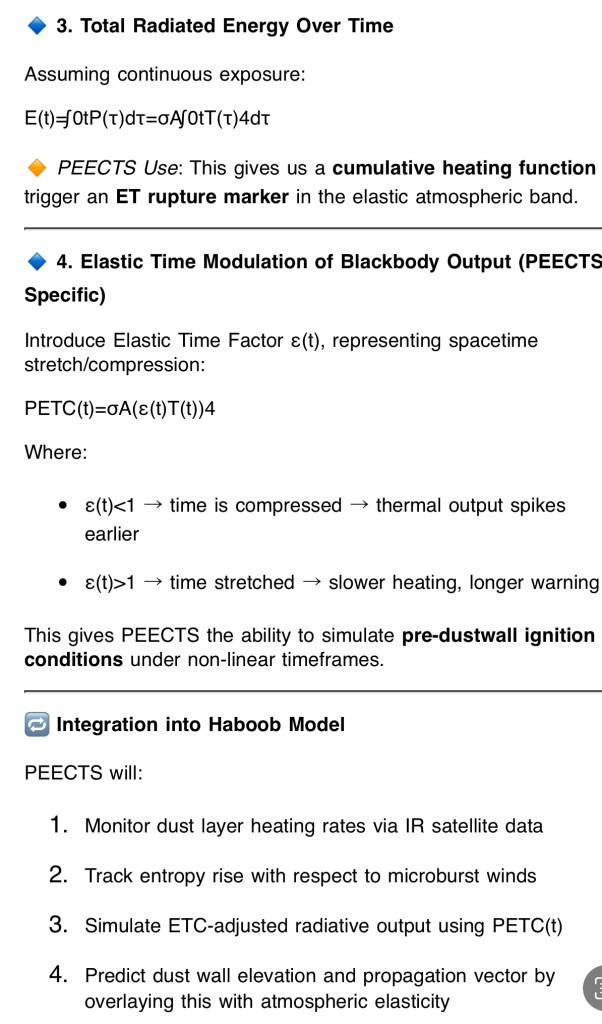
PEECTS posits that microbursts are preceded by elastic spacetime contractions caused by extreme pressure differentials. This means that time distortion patterns in storm cells could serve as early-warning indicators before the gust front releases dust.
- Prediction Hook: Use satellite or Doppler radar to detect elastic pre-collapse time compression in storm cells—analogous to the PEECTS “ETC” (Elastic Time Correction) applied in volcanic models.
2. Entangled Particle-Dust Wave Coupling
Haboobs carry particles up to 5,000 feet high, driven by surface-level entangled turbulence. PEECTS can model this as atemporally palindromic resonance, where pressure collapse, wind burst, and dust propagation are time-locked across layers (atmospheric, surface, and soil moisture).
- PEECTS Application: Detect early coupling between:
- Soil electrostatic charge differentials
- Atmospheric pressure oscillations
- Local geomagnetic distortions
These are seen in volcanic ash events as well—PEECTS already models this coupling.
3. PEECTS Mirror Trajectory Forecasting
Rather than linear projections, PEECTS uses entangled mirror logic to project multi-branch probable trajectories of dust walls—where the dust front bounces between palindromic echo points.
- Benefit: Can simulate potential trajectories for sudden turns or bifurcations in dust movement, which classical models miss.
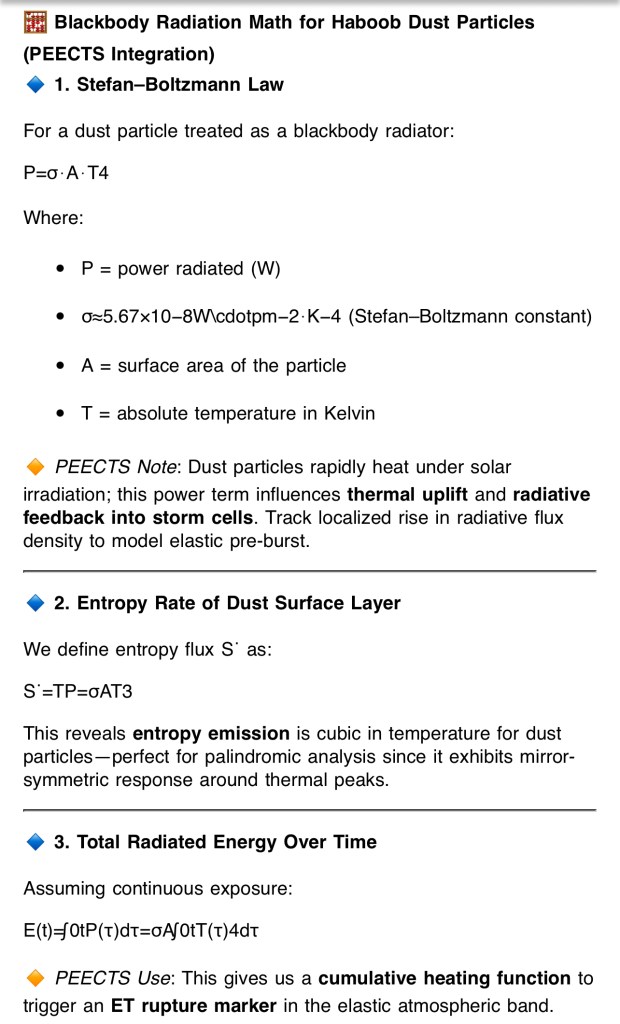
4. Blackbody Heat Absorption Precursor (Thermodynamic Entropy Clue)
As dust particles absorb solar radiation, they alter thermal gradients. PEECTS tracks palindromic entropy reversal patterns (rise → fall → reverse → collapse) that may precede the formation of the dust front.
- Model Input: Surface infrared satellite data + ground thermodynamic readings.
🛰️ Integration Suggestions
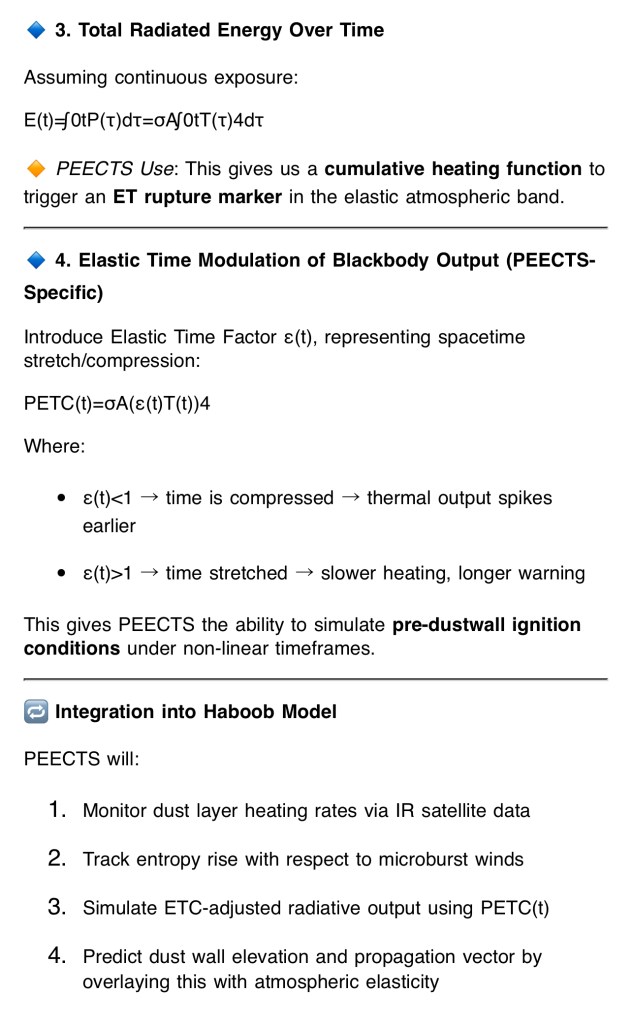
To embed PEECTS into Haboob forecasting systems:
- Combine real-time Doppler radar, infrared satellite, LIDAR, and magnetometer data
- Feed into a PEECTS time-elastic simulator trained to detect pre-collapse pressure loops
- Use Elastic Time Tagging to timestamp microbursts and correlate with dust front velocity evolution
🔁 Summary
PEECTS can predict haboobs earlier than traditional models by:
- Tracking elastic spacetime compression in storm cells
- Modeling dust–wind–time entanglement
- Applying mirror trajectory simulations
- Monitoring entropy reversals in soil/air systems
This represents a shift from “event-after-data” to “pre-collapse recognition via Elastic Time patterns”—the core strength of the PEECTS approachPEECTS Dr Santa.
Any questions, write.
 A New Theory of the Universe: Palindromic Entangled Elastic Time Strings Theory “