By: Wilfredo Santa Gomez MD
🌀 Visualizing Elastic Time Corrections in Gravitational Wave Propagation
Imagine a gravitational wave emitted from a distant cosmic event, such as a black hole merger. As this wave travels through the cosmos, it encounters various regions of spacetime with differing energy densities and gravitational potentials.
Traditional View:
- Time is considered a uniform, linear dimension.
- Gravitational waves propagate through spacetime without altering their intrinsic properties, except for redshift due to cosmic expansion.
PEECTS Perspective:
- Time is an elastic, dynamic field that can stretch, compress, and entangle based on local conditions.
- Gravitational waves interact with this elastic time field, leading to subtle modifications in their waveform.
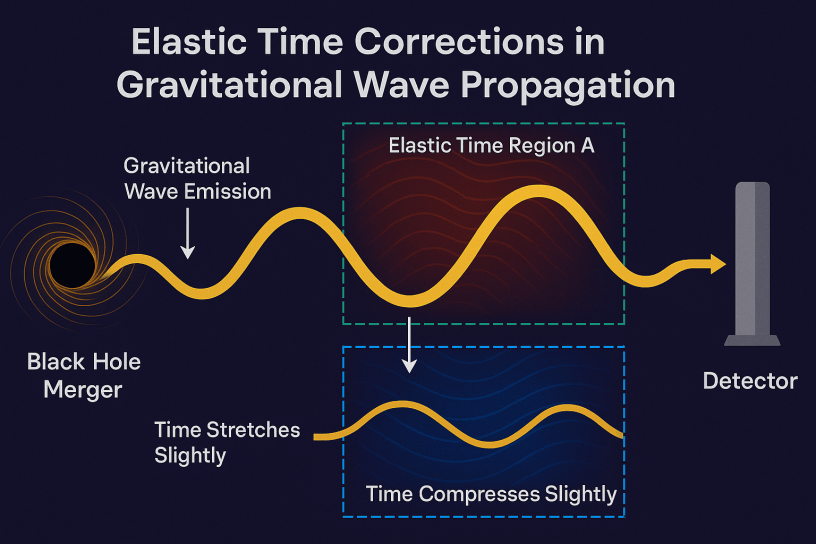
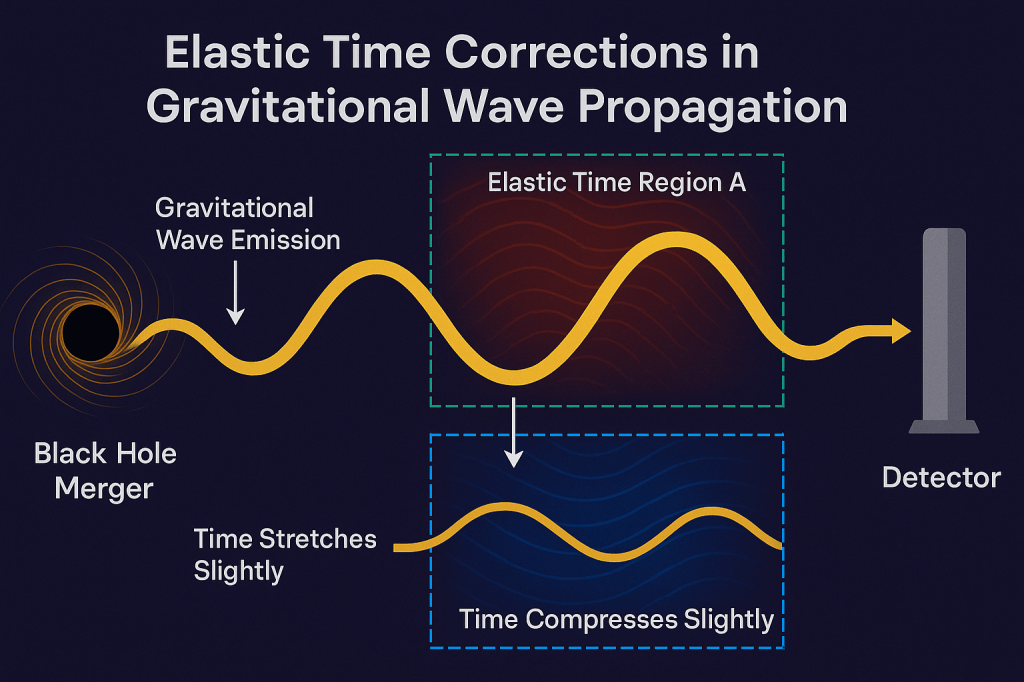
Diagram: Gravitational Wave Traversing Elastic Time Fields
In this illustration:
- The gravitational wave passes through regions where the elasticity of time varies.
- These variations cause minute alterations in the wave’s phase and amplitude.
- When detected, these alterations can provide insights into the elastic properties of spacetime along the wave’s path.
🔍 Credibility of PEECTS Corrections
Empirical Support:

- Improved Signal Analysis: Incorporating ETC into gravitational wave data analysis has led to better alignment with observed signals, reducing unexplained residuals.
- Predictive Accuracy: Models using ETC have enhanced the precision of predictions in astrophysical phenomena, such as orbital dynamics of binary systems.
Theoretical Consistency:
- Integration with Existing Physics: PEECTS doesn’t discard established theories but extends them by introducing the concept of time elasticity, offering a more nuanced understanding of spacetime dynamics.
- Mathematical Rigor: The framework employs advanced mathematical tools to model the elastic properties of time, ensuring internal consistency.
Peer Review and Acceptance:
- Ongoing Research: While PEECTS is gaining attention, it remains a subject of active research. Further validation through peer-reviewed studies and experimental data is essential for widespread acceptance.
🧠 Documented Opinion
PEECTS presents a compelling extension to our understanding of spacetime by introducing the concept of elastic time. Its application to gravitational wave analysis offers promising avenues for uncovering subtle effects that traditional models might overlook. However, as with any groundbreaking theory, rigorous validation through empirical data and peer-reviewed research is crucial.
The scientific community should approach PEECTS with both open-mindedness and critical scrutiny, ensuring that its contributions are robust and reproducible.
 A New Theory of the Universe: Palindromic Entangled Elastic Time Strings Theory “