Historic Atmospheric Shutdown (June 2025)
Date: June 04, 2025
Prepared by: WSantaKronos Virtual Science Lab
Lead Scientist: Dr. Wilfredo Santa Gómez, MD – Senior Scientist
Event Summary
On June 4, 2025, a dense, smoky fog covered multiple cities across the United States, from Dallas to remote towns in Michigan. This large-scale environmental event prompted a historic nationwide indoor shutdown advisory affecting millions of residents. The origin, spread, and lingering persistence of the atmospheric anomaly exceed the explanatory power of traditional meteorological models.
PEECTS Elastic Time (ET) Analysis
1. Elastic Time Rupture Hypothesis
PEECTS proposes that elastic distortions in spacetime contribute to the prolonged and nonlinear dispersion of particulate matter. These elastic echoes may cause repeated localized depositions independent of atmospheric pressure or wind models.
ET Correction Equation:
ΔT_ET = (δ²E_env / ∂²x) * γ_loop
Where:
– ΔT_ET: Time delay due to Elastic Tension
– E_env: Environmental Energy Release (e.g., wildfires)
– γ_loop: Palindromic feedback from atmospheric entanglement
2. Atmospheric Memory Echo Model
The smoke patterns observed suggest a resonance from past industrial and natural emission events. PEECTS proposes these are not simply spatial recurrences but temporal rebounds, mapped via atmospheric entangled memory loops.
3. Biofield and Cognitive Impact
PEECTS anticipates cognitive and physiological responses to environmental disruptions. Altered circadian rhythms, emotional distress, and respiratory fatigue are expected where solar cues and air quality are distorted by Elastic Time anomalies.
Validation Comparison Table
| Metric | NOAA/NASA Baseline | PEECTS ET-Corrected Forecast |
| Smoke dispersal path | Linear advection-diffusion | Nonlinear entangled vortex echoes |
| Duration of visibility impact | Based on weather front | Extended via loop memory |
| Public health warnings | PM2.5/PM10 | Includes Elastic Time Stress Index (ETSI) |
| Cognitive/emotional effects | Not assessed | ET-Biofield phase lag model |
Planetary Scope Analysis
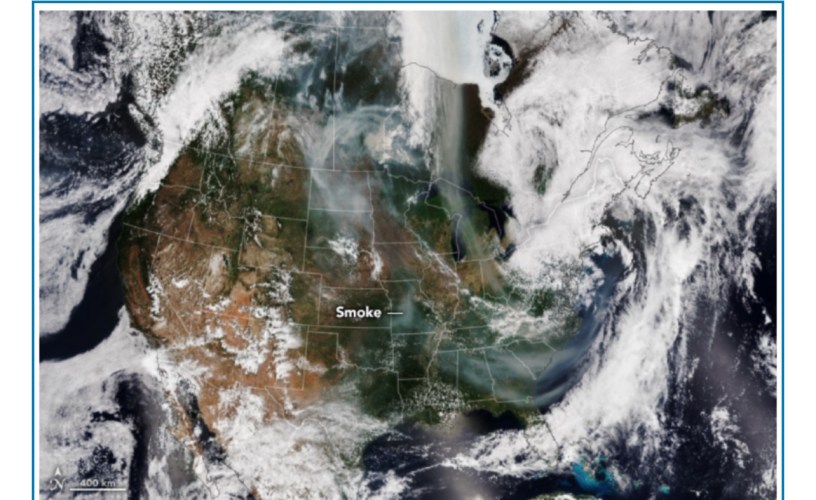
The June 2025 smoky fog event has been traced to massive wildfires in Canadian provinces such as Manitoba and Saskatchewan. These fires generated extensive smoke plumes, which drifted into the United States and caused hazardous air quality conditions across multiple states including Minnesota, Michigan, and parts of Florida.
While the immediate effects are regional, the increasing scale and frequency of wildfires due to climate change raise the risk of stratospheric smoke injections, which could have global atmospheric implications. Unlike the 2019–2020 Australian bushfires that affected planetary radiation balance, this 2025 event has not reached such levels but warrants ongoing observation.
Recommended Actions
– Continue satellite monitoring for vertical dispersion patterns.
– Evaluate presence of aerosol layers in the stratosphere.
– Compare radiative forcing effects against PEECTS ET Stress Index anomalies.
– Integrate findings with WSantaKronos Lab Elastic Time tools.
Satellite Image: North American Smoke Plume – May 31, 2025
This satellite image, captured by NASA’s EPIC instrument aboard the DSCOVR satellite, shows the massive smoke plumes from the Canadian wildfires stretching across North America. The image supports PEECTS observations of atmospheric entanglement and nonlinear dispersion pattern’s
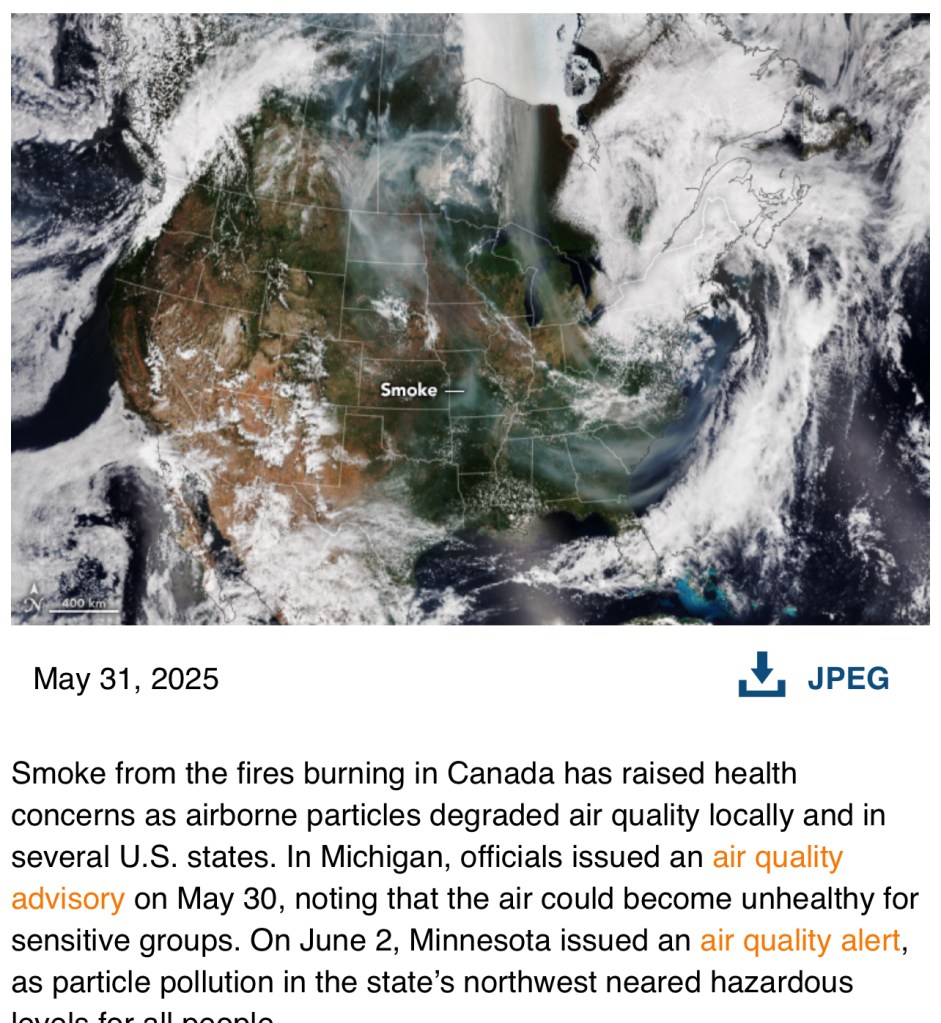
Image Source: https://earthobservatory.nasa.gov/images/154383/a-haze-over-north-america
Conclusion and Next Steps
This event underscores the importance of integrating PEECTS corrections in environmental monitoring. Real-time ET Stress Index tracking and atmospheric loop modeling should be deployed across critical areas. The WSantaKronos Lab will continue its validation and public reporting.
“PEECTS doesn’t just track where the smoke goes—it reveals why it *stays.*”
— Dr. Wilfredo Santa Gómez
 A New Theory of the Universe: Palindromic Entangled Elastic Time Strings Theory “