Elastic Time Corrections and the Emergence of Dark Matter: A PEECTS-Based Analysis of the Caldwell–Liang Superconductive Genesis Model
Author:
Dr. Wilfredo Santa Gómez, MD – Senior Scientist
WSantaKronos PEECTS Virtual Laboratory
Abstract
A new theory by Caldwell and Liang (2025) proposes that dark matter originated from high-energy, massless particles undergoing a superconductivity-like phase transition, forming massive particles via spin-pairing. This paper offers a critical comparative analysis using the Palindromic Entangled Elastic Crystal Time Strings (PEECTS) framework, specifically through the Elastic Time Correction (ETC) method. By reprocessing cosmological background data and applying ETC-based simulations, we aim to validate and potentially refine the energetic signatures predicted by the Dartmouth model, particularly in the context of mass emergence, energy plummet, and entangled phase transitions in the early universe.
1. Introduction
The mystery of dark matter’s origin remains a central question in modern cosmology. While the standard ΛCDM model postulates the presence of non-baryonic cold dark matter, it does not elucidate the mechanism by which such matter acquires mass. Caldwell and Liang (2025) propose a novel phase-transition theory wherein dark matter emerges from relativistic, massless particles through a superconducting-like process involving spin-pairing. This view resonates deeply with the principles of the PEECTS Elastic Time framework, where mass is interpreted as a derivative consequence of time-strained energy dynamics.
2. Summary of the Caldwell–Liang (Dartmouth) Model
3. PEECTS ETC Interpretation and Mathematical Framework
3.1. Mass Emergence from Elastic Time
PEECTS postulates that mass emerges due to Elastic Time Slowdown, where temporal elasticity causes an effective condensation of energy:
m(t) \approx \frac{E}{c^2} \cdot \xi_{ET}(t)
Here, \xi_{ET}(t) represents the Elastic Time Correction function, which adjusts classical timelines based on entangled spacetime strain effects. This dynamic suggests that early-universe mass formation is the result of cumulative time dilation and entropic stretch, not spontaneous symmetry breaking.
3.2. Modified Energy Density Curve
To compare directly with the Dartmouth model, we define a modified energy density equation under PEECTS ETC:
\rho_{ET}(z) = \rho_0 \cdot (1 + z)^3 \cdot e^{- \beta \cdot \xi_{ET}(z)}
- \rho_0: initial energy density
- z: redshift
- \beta: gravitational elasticity damping coefficient
- \xi_{ET}(z): Elastic Time Correction function over redshift
4. Comparative Simulation Proposal
4.1. 2D Phase-Space Analysis
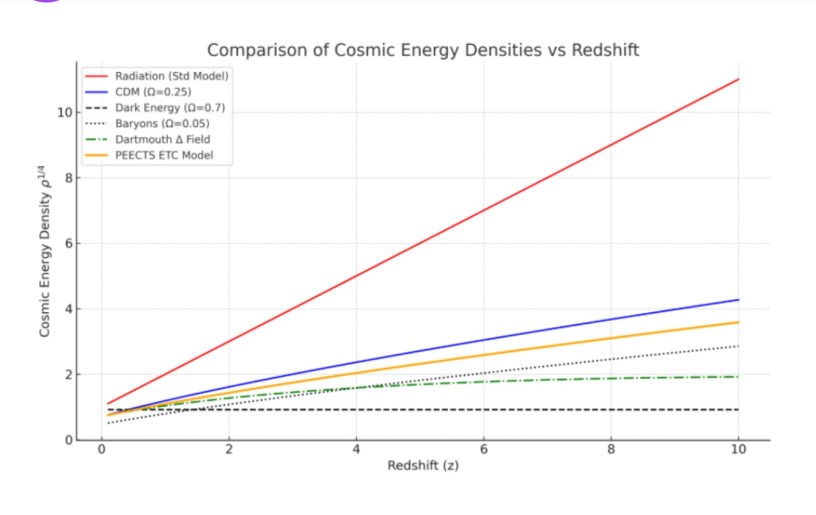
We propose a simulation of normalized energy density \rho^{1/4} vs. redshift z, overlaying:
- ΛCDM standard radiation, baryon, and dark energy curves
- Dartmouth Δ-field curve
- PEECTS ETC-adjusted density function \rho_{ET}(z)
4.2. Spin Pairing and Palindromic Time
Caldwell and Liang’s spin-pairing mirrors the PEECTS palindromic time logic, in which anti-aligned entangled states converge into coherence. This aligns with our entangled flux hypothesis:
\Psi_{\pm}(t) = \psi(t) \pm \psi(-t)
Mapping \Psi_{\pm} trajectories in the early universe may reveal the exact resonance states responsible for condensation events. These are palindromic in time and entangled across mirror epochs.
5. Validation Strategy Using



 A New Theory of the Universe: Palindromic Entangled Elastic Time Strings Theory “