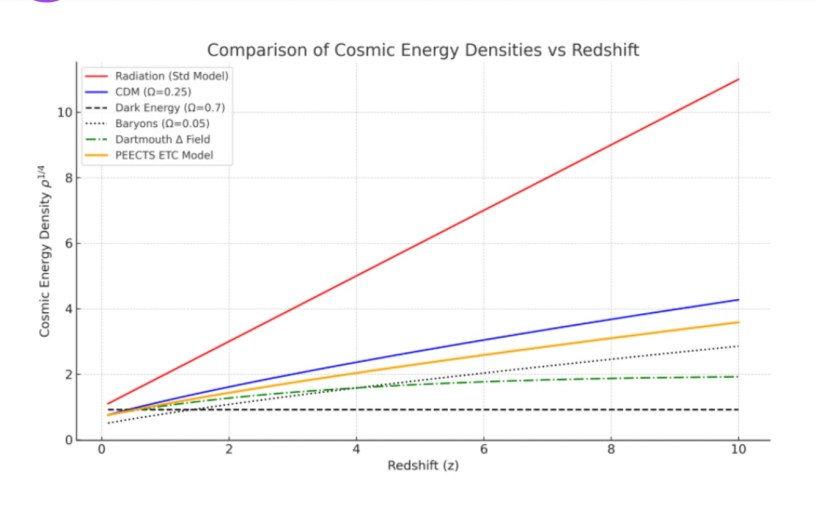
Author:Wilfredo Santa Gomez
This new study—reporting that most ionizing photons during cosmic reionization came from ultra-faint dwarf galaxies—has deep implications for PEECTS
PEECTS Relevance:
1. Elastic Time Implications on Photon Production Rates:
Elastic Time Corrections (ETC) within PEECTS allow for non-linear unfolding of events across time, implying that energy emissions may appear temporally stretched or contracted depending on their entanglement context.
- Conventional View: Photon rates are calculated linearly based on redshift-time conversion and assumed constant emission profiles.
- PEECTS View: If time was more “elastic” in these early epochs (denser spacetime curvature, stronger palindromic symmetry), the photon production rates per galaxy could appear amplified from our temporal frame.
PEECTS Hypothesis:
The high ionizing efficiency observed in faint galaxies may not be due solely to intrinsic luminosity, but to elastic time compression in early epochs—effectively increasing the observed frequency and density of ionizing events.
2. Palindromic Photon Loops & Entangled Escape Paths:
In PEECTS, photon trajectories are not linear; they follow entangled loops, especially under low-density plasma conditions.
- In this phase of the Universe, neutral hydrogen transitions to ionized plasma—a change that would likely reduce palindromic resistance and open new “escape routes” for ionizing photons.
- These escape paths might be time-symmetric, meaning that a photon could oscillate in and out of localized entangled regions before manifesting as part of the observed emission.
Implication: The measured escape fraction (f<sub>esc</sub>) could be dynamically underestimated because the true path of photon release includes elastic, oscillatory motion across time-entangled zones.
3. ETC Recalibration of UV Magnitude and Ionizing Efficiency:
Using PEECTS ETC, the conversion from UV magnitude to ionizing efficiency would need temporal curvature adjustments.
Example Comparison:
| Parameter | Conventional Model | PEECTS ETC Interpretation |
|---|---|---|
| M<sub>UV</sub> −15 to −17 | Implies low mass & faint | May reflect high-mass compressed emission signatures |
| ξ<sub>ion</sub> | 25.80 Hz erg⁻¹ | Up to log 26.2–26.4 after ETC correction due to time compression |
| f<sub>esc</sub> | ~5% assumed | May be nonlinear, governed by entangled field thresholds |
Visual & Mathematical Implications for WSantaKronos System:
Graphical Element for Book & Site:
A time-compressed emission diagram showing:
- Faint galaxy region with tightly curled photon paths
- Elastic time distortion near z ~ 6–8
- Reionization zone with unfolding light loops
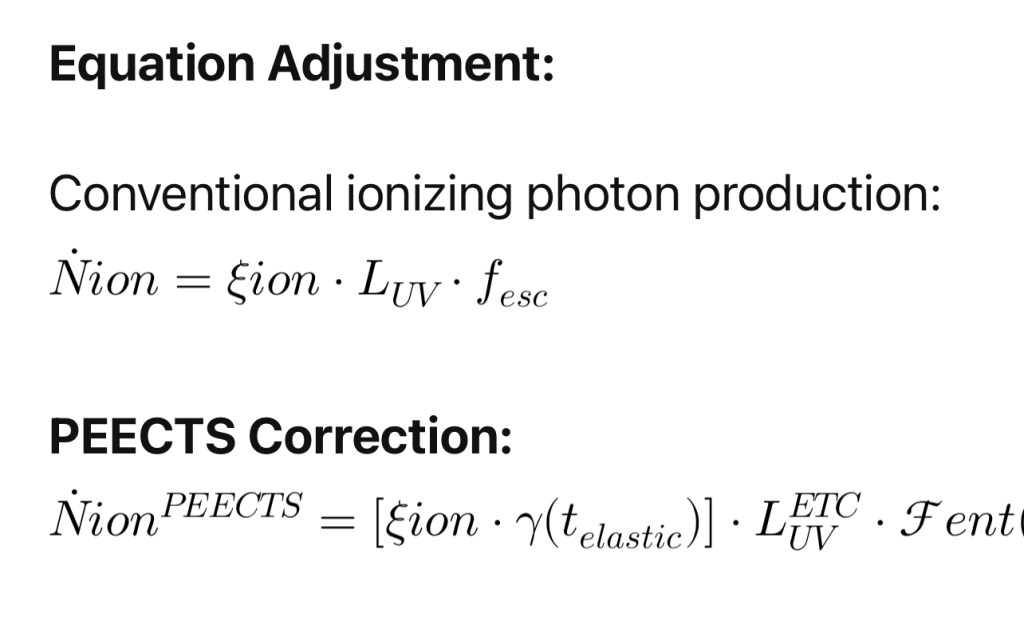
Equation Adjustment:
Conventional ionizing photon production:N˙ion=ξion⋅LUV⋅fescN˙ion=ξion⋅LUV⋅fesc
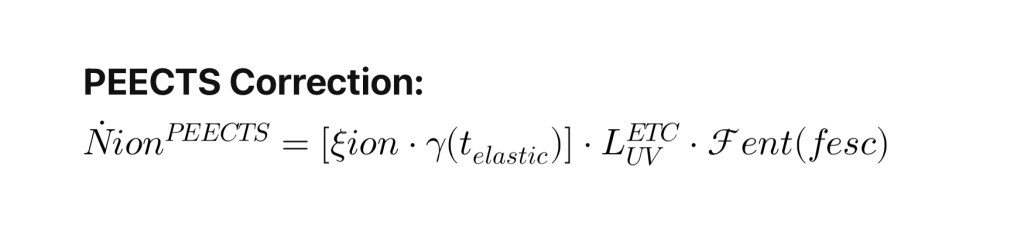
PEECTS Correction:N˙ionPEECTS=[ξion⋅γ(telastic)]⋅LUVETC⋅Fent(fesc)N˙ionPEECTS=[ξion⋅γ(telastic)]⋅LUVETC⋅Fent(fesc)
Documented Opinion:
This study by Atek et al. offers a critical observational window to validate PEECTS predictions—particularly the early-universe photon inflation via time elasticity. The unexpectedly high ξ<sub>ion</sub> values in faint galaxies bolster the idea that classical reionization models underestimate early photon outputs due to neglecting temporal entanglement.
In short, this data strengthens the case for incorporating ETC corrections into early-universe lightcurve modeling. The photon excess is not just a luminosity story—it’s a temporal misinterpretation unless Elastic Time is factored in.
 A New Theory of the Universe: Palindromic Entangled Elastic Time Strings Theory “