Wilfredo Santa Gómez
1. PEECTS and Suppressed Growth: Predictions
If PEECTS plays a role in the structure growth suppression, we should expect to see specific signatures in observational data that can differentiate it from standard ΛCDM explanations.
(a) Nonlinear Time Elasticity Signatures
- PEECTS suggests that Elastic Times could vary depending on mass-energy distributions. This would imply:
- A systematic shift in galaxy formation epochs as a function of local energy density.
- A redshift-dependent variation in the growth rate of cosmic structures, beyond what is predicted by standard dark energy models.
- A potential delay in baryonic structure formation in high-energy-density regions due to temporal elasticity effects.
✅ Testable Hypothesis: Upcoming surveys (e.g., Euclid, Roman Space Telescope) should detect unexpected correlations between structure formation timelines and local variations in mass-energy distribution.
(b) Long-Range Entanglement and σ₈ Tension
- PEECTS proposes that structure formation is influenced by quantum-scale entanglement effects that persist at cosmic scales.
- This could mean that galaxy clustering is subtly constrained by a nonlocal feedback mechanism preventing excessive density fluctuations.
✅ Testable Hypothesis:
- Deviations in the two-point correlation function of galaxy clustering, especially at intermediate redshifts.
- Cosmic structures displaying unexpectedly smooth density gradients at scales where standard gravitational collapse models predict stronger clustering.
📊 Experimental Design:
- Compare BOSS data with next-gen deep-field observations (JWST, Vera Rubin Observatory) to check if PEECTS’ entanglement effects lead to statistically significant smoothing of large-scale structures.
2. Resolving the Hubble Tension
PEECTS posits that different regions of spacetime may experience varying elastic time effects, leading to discrepancies in local vs. global Hubble measurements.
✅ Testable Hypothesis:
- Time elasticity should predict a systematic offset between Cepheid-based Hubble measurements (local universe) and early-universe predictions (CMB, BAO) that cannot be fully explained by standard dark energy models.
- If elastic time effects exist, we should observe anisotropies in the inferred expansion rate across different directions of the sky.
📊 Experimental Design:
- Use multi-directional H₀ measurements from gravitational wave standard sirens (LIGO, future LISA) to detect any direction-dependent variations in the inferred Hubble constant.
- Check if these variations correlate with cosmic web density fluctuations, which PEECTS suggests should regulate time elasticity.
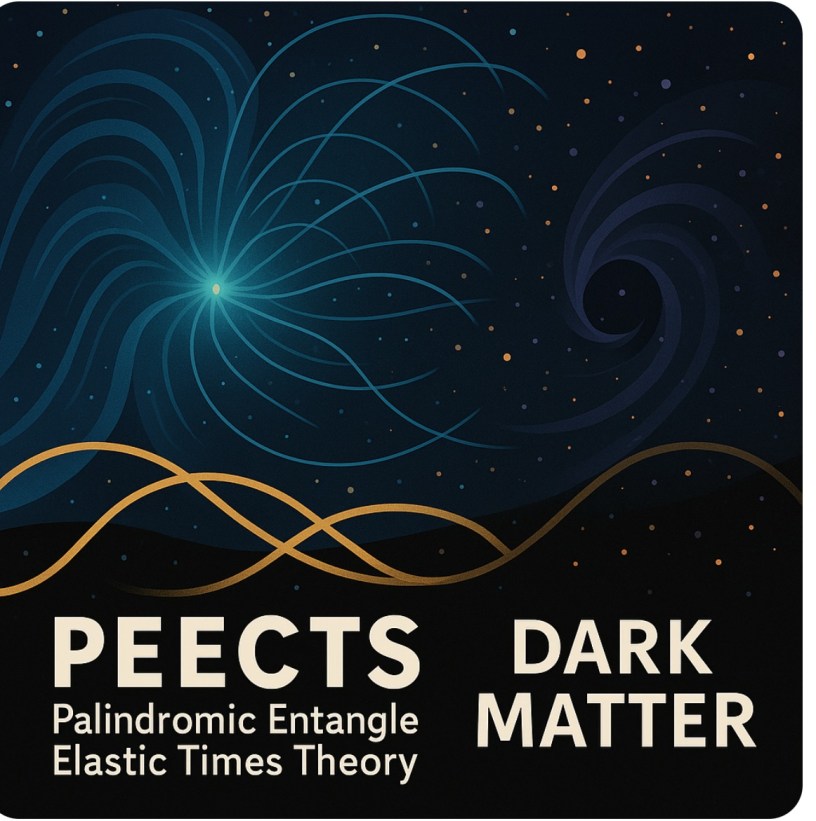
3. Dark Matter as Elastic Energy Condensates
If dark matter is not a particle but instead an emergent effect of elastic energy condensates (as PEECTS suggests), then:
- It should interact differently than expected with baryons, possibly leading to subtle suppression of structure formation.
- Dark matter could act as a medium that stabilizes large-scale density fluctuations, consistent with the observed σ₈ suppression.
✅ Testable Hypothesis:
- In regions of high dark matter density, structure growth suppression should correlate more strongly than expected with local gravitational potentials.
- Future lensing surveys should detect anomalous weak lensing signals due to the non-particle-like behavior of elastic condensate dark matter.
📊 Experimental Design:
- Cross-correlate weak lensing maps from DESI, LSST, and Euclid with galaxy clustering data to identify suppressed structure growth signatures in high-density dark matter regions.
Concluding Thoughts
PEECTS provides a unique framework that naturally accounts for suppressed structure growth, Hubble tension, and dark matter interactions without requiring exotic new particles or modifications to general relativity. The key experimental signatures—nonlinear time elasticity, large-scale entanglement effects, and dark matter as an elastic condensate—are all testable with next-generation astronomical surveys.
Follow up… for more information!
 A New Theory of the Universe: Palindromic Entangled Elastic Time Strings Theory “