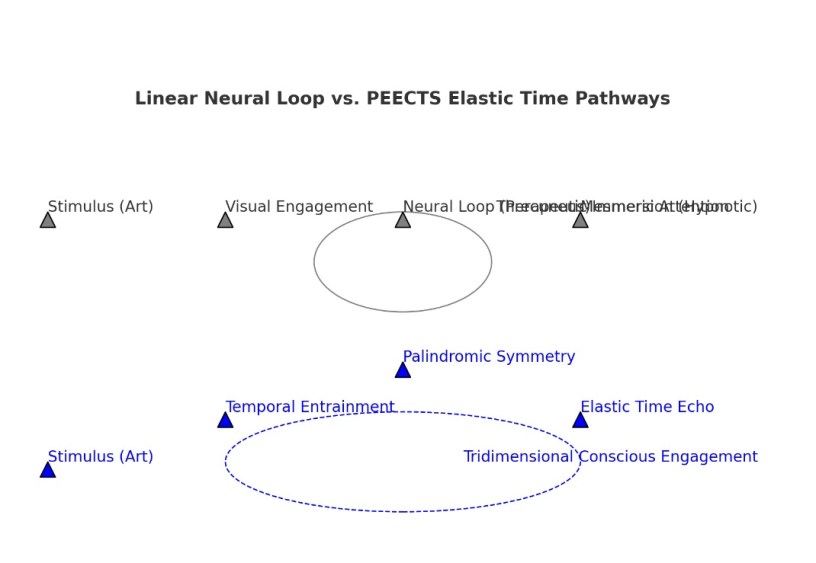
Documented Opinion: Why PEECTS Rejects the Linear Neural Loop Model?
Author: Dr.Wilfredo Santa Gomez
1. PEECTS defines time as elastic and entangled—not linear:
- Traditional neuroaesthetic theories presume a linear, feedforward model of cognition—stimulus in, perception, then emotional response.
- PEECTS sees time as a nonlinear, multi-directional field, where mirror symmetries, temporal recursion, and entangled moments co-generate conscious experiences.
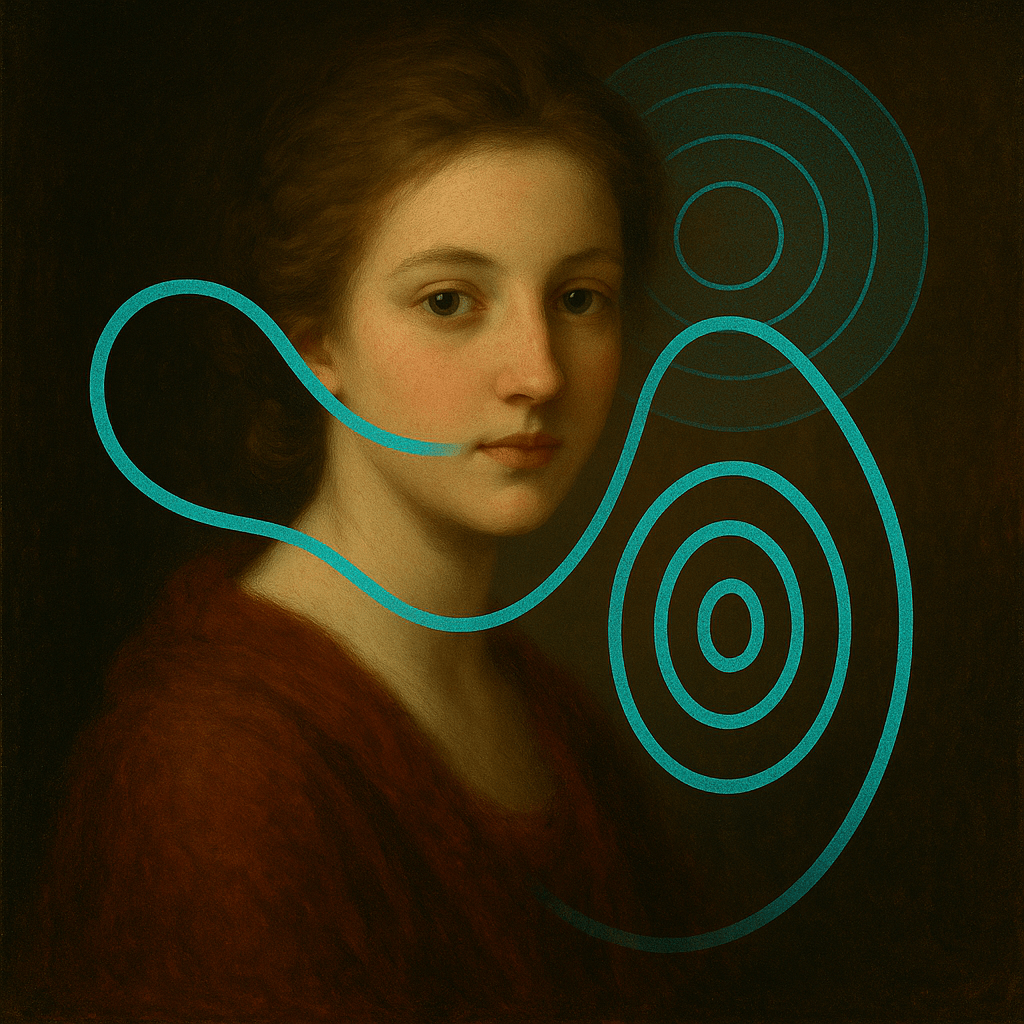
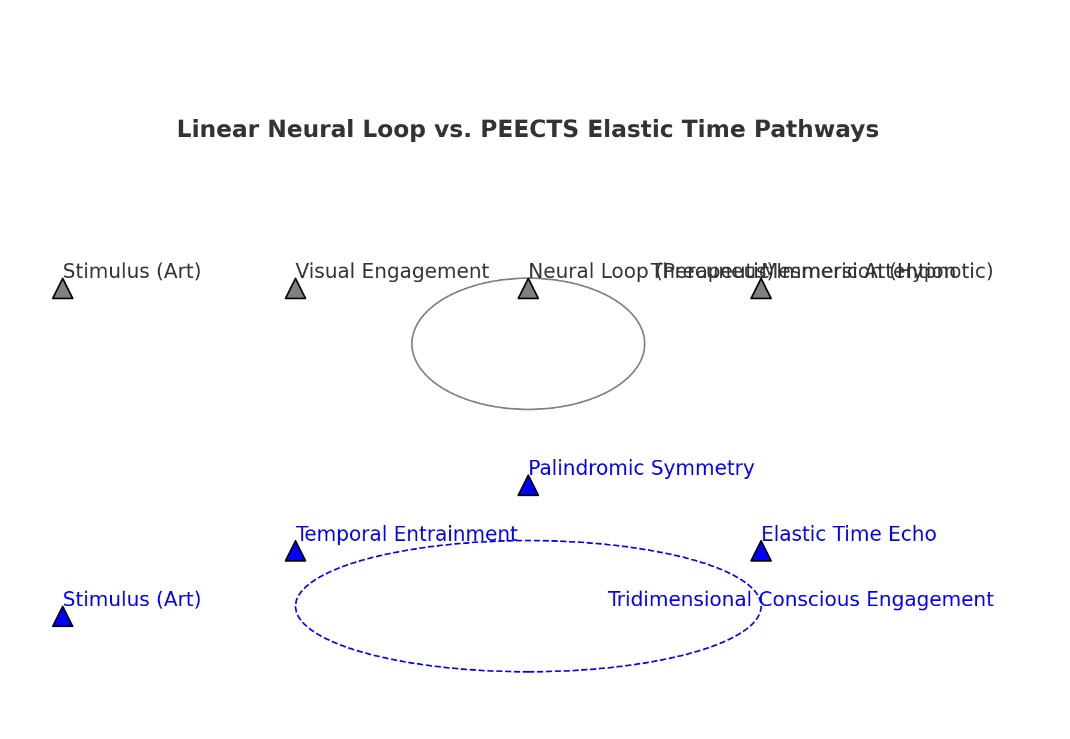
2. Neural loops are closed feedback circuits—not time-crystal structures:
- While neural loops do create repetitive engagement (e.g., rhythm in music or patterns in visual art), these are hypnotic entrapments—they trap attention in a local temporal vortex.
- PEECTS instead proposes temporal membranes that interact across dimensional time, forming palindromic entrainment rather than entrapped attention.
3. The “precuneus engagement” hypothesis (used in VR/art therapy) is functionally dissonant with PEECTS:
- Activating the precuneus may foster visual immersion, but in PEECTS terms, it bypasses elastic cognitive layering, resulting in flattened consciousness (akin to being mesmerized).
- PEECTS suggests that true therapeutic engagement requires opening multidimensional time paths (not just immersive hypnosis).
Alternative Explanation Through PEECTS
Instead of viewing art as causing loop-based entrapment, PEECTS would reframe it as:
- A potential bridge between elastic temporal states and neural perception.
- Valid only if the artwork or stimulus evokes palindromic time echoes—not repetitive loops.
Revised Implications (PEECTS-Compatible):
- Visual compositions may entrain the brain if they resonate with palindromic time fields—e.g., recursive golden ratios, bilateral symmetry that echoes across time.
- VR and AI art generators could be retrained to simulate elastic time distortions, allowing users to experience forward-reverse temporal motion consciously.
- Therapeutic outcomes must be linked to time-axis diversification, not just repetitive neural engagement.
 A New Theory of the Universe: Palindromic Entangled Elastic Time Strings Theory “