
Author’s Note (Personal Statement)
As the architect of the Mirror Terminal and the PEECTS model, I invite you to engage not only with equations and simulations, but with a vision. This project was born not from theory alone, but from lived experience—navigating uncertainty, discovering structure within chaos, and building clarity through reflection. What you see here is not a finished system, but a living organism of thought, evolving with each discovery and calibration. Let this volume be both a guide and a record of the science we dared to reimagine.
2. Philosophical Statement – Future of Science via Virtual Labs
Defines the paradigm shift—both scientific and cultural.
Draft:
We are witnessing the end of static science. The future belongs to adaptive, real-time laboratories—where the observer, model, and data coexist in continuous entanglement. Virtual labs like WSantaKronos do not simulate reality; they refine it. By embedding time elasticity and palindromic structure into our modeling, we not only increase accuracy—we uncover truths previously hidden by our assumptions about time, cause, and observation. This is not a tool for replication, but for revelation.
3. Historical Evolution of PEECTS During the Pandemic
A unique narrative grounding the theory in a transformative global moment.
Draft:
The birth of the PEECTS model coincided with a planetary standstill. During the pandemic’s quiet rupture of normalcy, time itself appeared to shift—stretching, reversing, repeating. These subjective impressions became hypotheses; those hypotheses became simulations. As global science turned inward, the PEECTS theory turned temporal irregularities into mathematical insight. What began as a private exploration of elastic time during isolation has become a public scientific framework—tested across gravitational waves, environmental models, and quantum signatures.
Introduction to the PEECTS Theory
Palindromic Entangled Elastic Time Strings
By Dr. Wilfredo Santa Gómez
PEECTS offers a paradigm shift in our understanding of time—reframing it as elastic, multidirectional, and entangled, capable of responding to quantum, cosmic, and conscious processes.
What is PEECTS?
PEECTS (Palindromic Entangled Elastic Time Strings) is a theoretical framework proposing that time behaves like a flexible, responsive medium. Instead of progressing linearly, time in this model stretches, loops, and links across different scales, allowing past, present, and future to influence one another.
Core Principles
- Temporal Elasticity: Time can be stretched or compressed, adapting to energetic, gravitational, or informational changes in a system.
- Palindromic Symmetry: Temporal events can mirror forward and backward flows, suggesting bidirectional causality.
- Entanglement in Time: Events at different times can be linked nonlocally, akin to quantum entanglement across time.
- Onion-like Time Layers: Time exists in interacting, concentric shells, each representing a dimension of temporal influence.
- Conscious Interaction: Consciousness may not only perceive but also modulate time’s elastic properties.
Mathematical Representation
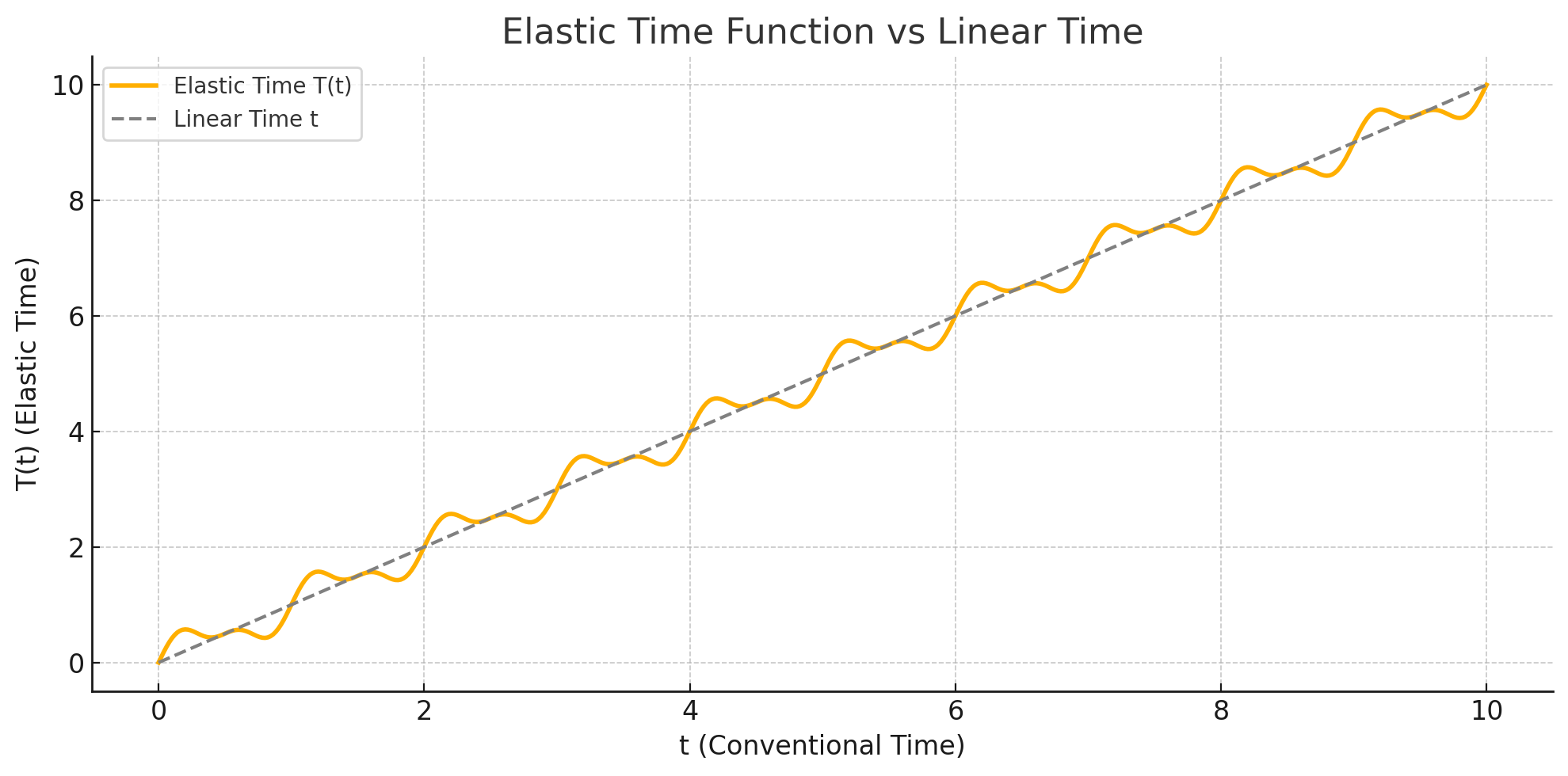
The elasticity of time is represented by modifying classical time as follows:
T(t)=t+∑n=1∞ϵnsin(ωnt)
- ϵn: Coefficients representing elastic modulation
- ωn: Frequencies of temporal resonance
This model introduces oscillatory corrections that can account for temporal anomalies observed in physical systems.
Connection with Hybrid Ecological Models
PEECTS builds upon the hybrid ecological model by John Harte, integrating elastic time dynamics into system-level feedbacks. It enables:
- Modeling of micro- and macro-scale interactions over elastic time coordinates
- Bidirectional causation in ecological and social disturbances
- Thermodynamic interpretations of time-reversible events
Scientific and Practical Applications
- Quantum Coherence: Time elasticity could stabilize entanglement over extended periods.
- Gravitational Memory: Offers new insights into post-wave residual distortions in spacetime.
- Cosmological Modeling: Alternative explanations for phenomena attributed to dark matter and energy.
Looking Ahead
Future chapters explore in depth:
- Experimental frameworks to detect time elasticity
- Simulation of PEECTS effects in gravitational and quantum systems
- Mathematical integration of PEECTS with contemporary physical laws
By offering a unified, multi-scale theory of time, PEECTS has the potential to reshape our fundamental understanding of reality.
 A New Theory of the Universe: Palindromic Entangled Elastic Time Strings Theory “