Author: Wilfredo Santa Gómez, MD
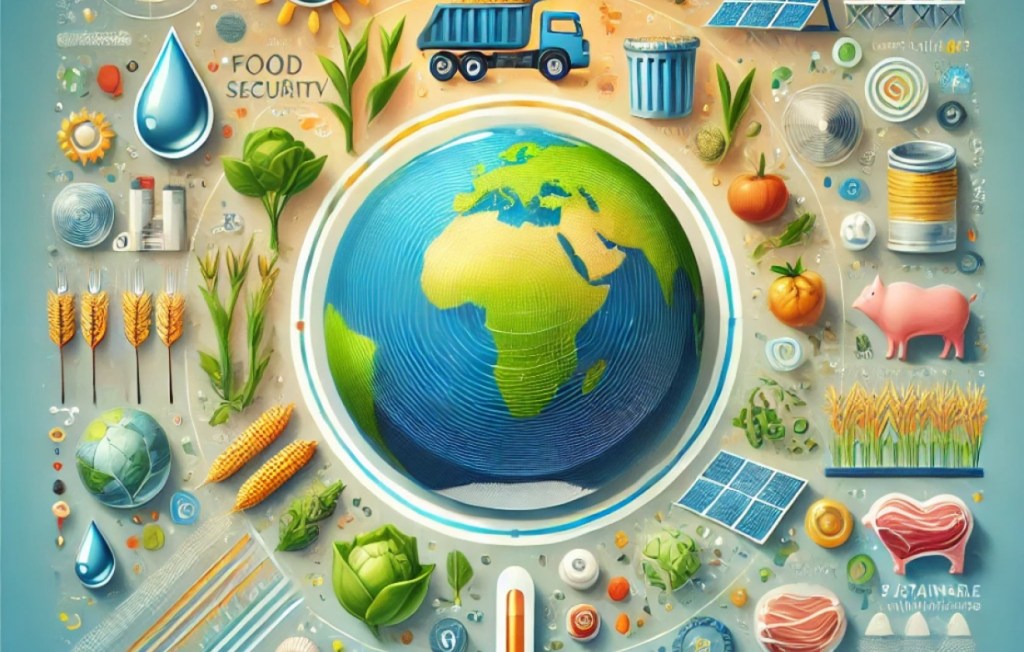
A visual representation based on the article’s content, highlighting the key challenges and solutions for global food security.
The Numbers That Define the Challenge
As of November 2024, the global population stands at 8.16 billion people and continues to grow. While the rate of growth has slowed, the sheer size of the population presents a fundamental question: Can we produce enough food to feed everyone, and how long can the planet sustain this demand?
To grasp the scale of the issue, consider this: the average person needs about 2,000 to 2,500 calories per day to stay healthy. For 8.16 billion people, this means producing 16.3–20.4 trillion calories daily, or 6,000–7,500 trillion calories annually. This translates into roughly 4.08 billion metric tons of food each year, consisting of grains, fruits, vegetables, and animal products.
On paper, global food production currently meets these requirements. But in reality, systemic inefficiencies like waste and unequal distribution mean that millions still go hungry. Astonishingly, the Food and Agriculture Organization (FAO) estimates that 30–40% of all food produced is wasted—enough to feed an additional 1–2 billion people.
A Growing Demand Amidst Growing Challenges
The population is projected to peak at 10.3 billion by 2085, demanding a 35–40% increase in food production over current levels. However, this isn’t as simple as planting more crops. Modern agriculture faces mounting challenges:
1. Climate Change
Rising temperatures, unpredictable weather patterns, and extreme events such as droughts and floods are already cutting into crop yields. By 2050, these climate impacts could reduce global agricultural output by as much as 25%.
2. Depleting Resources
Agriculture depends on finite resources like water, fertile soil, and arable land. Yet, 1% of arable land is lost annually due to urbanization, soil degradation, and overuse, while water scarcity threatens major food-producing regions.
3. Changing Diets
As incomes rise in developing countries, so does demand for resource-intensive foods like meat and dairy. Producing 1 kg of beef requires 15,000 liters of water, compared to just 1,500 liters for 1 kg of wheat. This shift puts even more strain on limited resources.
How Long Can We Keep Up?
If we continue on the current trajectory, without major innovations or policy shifts, global food supplies could fall short of demand in the next 20–30 years. Optimists, however, argue that new technologies and sustainability efforts could extend this timeline by another 50–60 years. But even under the best-case scenario, action is needed now to avoid a global crisis.
Rising to the Challenge: What Can Be Done?
The good news is that solutions exist, and they are within our reach—provided we act decisively and collaboratively. Here are the key strategies:o
1. Tackle Food Waste
Reducing food waste is the fastest and most efficient way to improve food security. In developing countries, better storage and transportation systems can prevent spoilage, while consumers in wealthier nations must learn to buy and use food more responsibly.
2. Adopt Sustainable Agriculture
Regenerative farming practices can restore soil health, increase yields, and reduce environmental harm. Technologies like drought-resistant crops and precision farming—using AI and sensors to optimize water and fertilizer use—are critical to producing more with less.
3. Shift Diets Toward Sustainability
A global shift toward plant-based diets could drastically reduce the environmental impact of food production. Protein-rich plants like beans, lentils, and chickpeas require far less water, land, and energy than animal-based proteins.
4. Embrace Innovation
Technological breakthroughs offer exciting possibilities. Lab-grown meat, vertical farming, and genetically modified crops could revolutionize food production, using fewer resources to produce more food in less space.
5. Strengthen Policy and Cooperation
Governments play a crucial role in ensuring equitable food distribution, funding agricultural research, and helping farmers adapt to climate change. Global collaboration is essential, as food security is a challenge that transcends borders.
Why This Matters
Si Food security is about more than just calories; it’s about ensuring that every person, no matter where they live, has access to nutritious, affordable food. It’s also about protecting the ecosystems and natural resources that sustain life on Earth.
The choices we make today—whether as policymakers, businesses, or individuals—will determine whether future generations inherit a world where food is abundant or scarce. Small actions, like reducing waste and choosing sustainable diets, add up. Big decisions, like investing in regenerative agriculture and climate-resilient technologies, can transform the global food system.
The future of food is in our hands. The question is not just whether we can feed a growing world, but whether we can do so while preserving the planet we all share. The time to act is now.
This blog post is a call to action, not just for policymakers and scientists, but for all of us. The future of food is in our hands. Will we rise to the challenge? Let’s start today.
References:
1. Miladinov, G. (2023). Impacts of population growth and economic development on food security in low-income and middle-income countries. Frontiers in Human Dynamics, 5(1121662). Retrieved from https://www.frontiersin.org/articles/10.3389/fhumd.2023.1121662/full
2. The Challenges and Strategies of Food Security under Global Change. (2023). MDPI Foods, 13(2083). Retrieved from https://www.mdpi.com/2304-8158/13/13/2083
3. Population and Food Systems: What Does the Future Hold? (2023). Population and Environment. Retrieved from https://link.springer.com/article/10.1007/s11111-023-00431-6
4. The Effectiveness of Food System Policies to Improve Nutrition. (2023). Springer Link. Retrieved from https://link.springer.com/article/10.1007/s12571-023-01385-1
5. How and Where Global Food Supplies Fall Short of Healthy Diets: Past Trends and Future Projections, 1961-2020 and 2010-2050. (2023). Costlow, L., Herforth, A., Sulser, T. B., Cenacchi, N., & Masters, W. A. arXiv. Retrieved from https://arxiv.org/abs/2401.01080
6. Exploration of Food Security Challenges Towards More Sustainable Food Systems. (2022). MDPI Foods, 11(3804). Retrieved from https://www.mdpi.com/2304-8158/11/23/3804
7. Reversing Years for Global Food Security: A Review of the Food Security Situation in Sub-Saharan Africa. (2022). MDPI International Journal of Environmental Research and Public Health, 19(14836). Retrieved from https://www.mdpi.com/1660-4601/19/22/14836
8. The State of Food Security and Nutrition in the World 2021. (2021). World Health Organization. Retrieved from https://www.who.int/publications/m/item/the-state-of-food-security-and-nutrition-in-the-world-2021
9. Exploring the Future of Land Use and Food Security: A New Set of Global Scenarios. (2020). PLOS ONE, 15(7), e0235597. Retrieved from https://journals.plos.org/plosone/article?id=10.1371%2Fjournal.pone.0235597
10. Belmeskine, R., & Benaichouche, A. (2023). A framework for evaluating the impact of food security scenarios. arXiv. Retrieved from https://arxiv.org/abs/2301.09320
These references are formatted for easy use in a scientific paper or blog post, providing proper attribution to the authors and sources. If you need them in a different citation style (e.g., MLA, Chicago), let me know!
 A New Theory of the Universe: Palindromic Entangled Elastic Time Strings Theory “