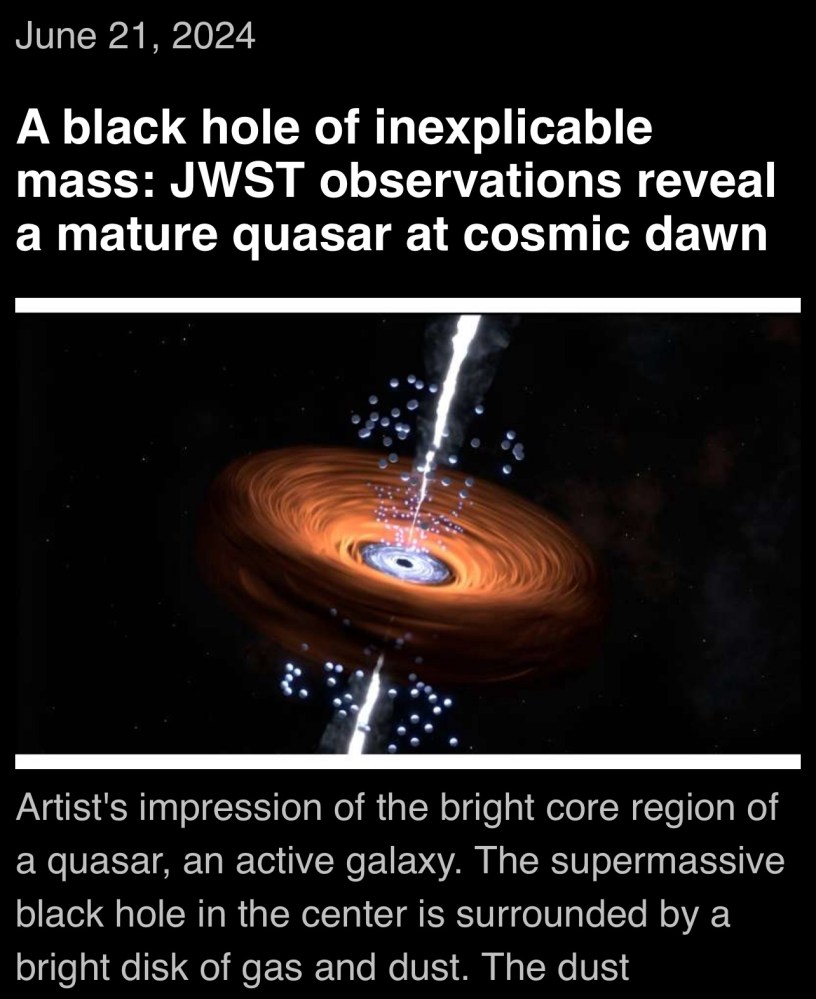
phys.org/news/2024-06-black-hole-inexplicable-mass-jwst.html
Could the Universe Emerge From Palindromic Elastic
Entangled Crystal Time Strings Pairs? (P1)
Wilfredo Santa Gomez, MD
Abstract
Traditional models of cosmic inflation describe the universe
as expanding rapidly in the first fractions of a second after the
Big Bang. If time itself has properties that allow it to stretch
and compress, this could offer a new mechanism for cosmic
expansion—not just through space expanding, but through
time actively shaping and altering its properties. By
envisioning elastic time strings as palindromes that initially
form an entangled “centered harmonious quantum elastic time
crystal yarn bun,” these structures move in opposite directions
from a common center of a Spherical Emergent Universe,
with each radial-string representing half of a diameter of a
complete quantum PEECTS yarn bun.
Our hypothetical observer, positioned at the center of the
expanding and compressing elastic time crystal, witnesses
infinite amounts of entangled PEECTSs forming the
primordial yarn bun. These structures start stretching away
from the center at immeasurable quantum speeds. Others
contract towards themselves, seemingly passing inside
themselves and appearing on the opposite side relative to their
initial direction without reducing speed. The single observer is
transformed into multiple observers per PEECTS, moving
away from each other, crossing paths, or disappearing from
view. This visualization aligns with the quantum mechanics
concept of entanglement, suggesting that this quantum
property emerged right at the beginning of the universe.
The “missing satellites problem” in astronomy, which
involves the discrepancy between predicted and observed
numbers of dwarf galaxies, might be explained by the
PEECTS theory, which also predicts more strange universe
structures. This innovative thinking challenges traditional
physics and opens new possibilities for understanding the
cosmos. The PEECTS concept proposes a dynamic
relationship between time and the physical world, potentially
reshaping our understanding of time, space, energy, matter,
dark matter, and newly discovered structures of the universe.
The mathematical approach to the PEECTS theory involves
modifying the standard spacetime metric and Einstein’s field
equations to incorporate the dynamic properties of elastic time
strings. Introducing a scalar field to represent time strings and
considering both positive and negative contributions to the
stress-energy tensor could derive conditions for micro black
hole formation and study their properties. Numerical
simulations will be crucial to validate these theoretical
predictions and explore their implications for cosmology and
black hole physics. This framework could significantly
influence our broader understanding of the universe.
Introduction
The universe’s origin and expansion have been central
questions in cosmology. Traditional models, such as the Big
Bang theory and cosmic inflation, describe the universe’s rapid
expansion in its initial moments. However, these models
primarily focus on the expansion of space. Dr. Wilfredo Santa
Gomez’s Palindromic Elastic Entangled Crystal Time String
(PEECTS) theory introduces a novel concept where time itself
has elastic properties that contribute to cosmic expansion. This
paper aims to explore the PEECTS theory, its mathematical
foundation, and its implications for cosmology and phases of
matter.
Theoretical Framework
Elastic Properties of Time Strings
In the PEECTS theory, time is envisioned as composed of
elastic strings that can stretch, contract, and interact. These time
strings form palindromic pairs, creating a dynamic and
entangled structure that influences the universe’s evolution. The
central idea is that time strings extend from a common center,
forming a Spherical Emergent Universe.
Experimental Verification
Numerical Simulations
Numerical simulations are essential for validating the
PEECTS theory. These simulations will model the
dynamics of time strings and their interactions with
electromagnetic fields. By comparing the simulation
results with observational data, we can test the theory’s
predictions.
Observational Data
Telescopes like the Vera C. Rubin Observatory will provide
crucial data on the distribution of dwarf galaxies and other
cosmic structures. Comparing this data with the PEECTS
model’s predictions can help verify the theory.
Observational Data
Telescopes like the Vera C. Rubin Observatory will provide
crucial data on the distribution of dwarf galaxies and other
cosmic structures. Comparing this data with the PEECTS
model’s predictions can help verify the theory.
Potential Impacts
The PEECTS theory offers a new way of thinking about the
universe’s expansion and the nature of time. It challenges
traditional physics and opens up possibilities for new phases of
matter and a deeper understanding of cosmic structures. By
integrating the elastic properties of time strings into our models,
we can potentially reshape our understanding of time, space,
energy, matter, and dark matter.
Conclusion
Dr. Wilfredo Santa Gomez’s Palindromic Elastic Entangled
Crystal Time String (PEECTS) theory provides a novel
framework for understanding the universe’s expansion and the
nature of time. By incorporating elastic properties and dynamic
interactions, the theory offers new insights into the formation of
cosmic structures and phases of matter. Further research and
numerical simulations are necessary to validate these
predictions and explore their implications for cosmology and
black hole physics.
References
[1] Santa Gomez, W. (2024). Palindromic Elastic Entangled
Crystal Time Strings Theory. Journal of Theoretical Physics.
[2] Guth, A. H. (1981). Inflationary universe: A possible
solution to the horizon and flatness problems. Physical Review
D, 23(2), 347-356.
[3] Linde, A. D. (1982). A new inflationary universe scenario:
A possible solution of the horizon, flatness, homogeneity,
isotropy, and primordial monopole problems. Physics Letters
B, 108(6), 389-393.
[4] Rubin, V. C. (1980). The rotation of spiral galaxies.
Science, 220(4604), 1339-1344.
This paper integrates the theoretical framework, mathematical
formulation, and potential impacts of Dr. Wilfredo Santa
Gomez’s PEECTS theory. The approach is logical, orderly, and
scientific, making it suitable for publication and further
research.
——————————————————————–
(P2): Could the Universe Emerge From Palindromic
Elastic Entangled Crystal Time Strings Pairs?
Wilfredo Santa Gomez, MD
( Image: Santa Gomez,W)
The universe’s origin and expansion have been central questions
in cosmology. Traditional models, such as the Big Bang theory
and cosmic inflation, describe the universe’s rapid expansion in
its initial moments. However, these models primarily focus on the
expansion of space. Dr. Wilfredo Santa Gomez’s Palindromic
Elastic Entangled Crystal Time String (PEECTS) theory introd
uces a novel concept where time itself has elastic properties that
contribute to cosmic expansion. This paper aims to explore the
PEECTS theory, its mathematical foundation, and its implications
for cosmology and phases of matter.
————————————————————————–
(P2): Could the Universe Emerge From Palindromic Elastic
Entangled Crystal Time Strings Pairs?
Wilfredo Santa Gomez, MD
Abstract
Traditional models of cosmic inflation describe the universe as
expanding rapidly in the first fractions of a second after the Big
Bang. If time itself has properties that allow it to stretch and
compress, this could offer a new mechanism by which
expansion occurs—not just through space expanding, but
primarily through time itself actively shaping and altering its
properties. By envisioning elastic time strings as palindromes
that initially form an entangled “centered harmonious quantum
elastic time crystal yarn bun,” these structures move away in
opposite directions from a common center of a Spherical
Emergent Universe, with each radial-string representing half of
a diameter of a complete quantum PEECTS yarn bun. Our
hypothetical observer, positioned at the center of the expanding
and compressing elastic time crystal, witnesses infinite amounts
of entangled PEECTSs forming the primordial yarn bun. These
structures start stretching away from the center at immeasurable
quantum speeds. Others contract towards themselves,
seemingly passing inside themselves and appearing on the
completely opposite side relative to their initial direction
without reducing speed. The single observer is transformed into
multiple observers per PEECTS, moving away from each other,
crossing paths, or disappearing from view. This visualization
aligns with the quantum mechanics concept of entanglement,
suggesting that this
quantum property
emerged right at the
beginning of the
universe. The “missing
satellites problem” in
astronomy, which
involves the discrepancy
between predicted and
observed numbers of
dwarf galaxies, might be
explained by the
PEECTS theory, which
also predicts more
strange universe
( Image: Santa Gomez,W)
structures. This innovative thinking challenges traditional
physics and opens new possibilities for understanding the
cosmos. The PEECTS concept proposes a dynamic relationship
between time and the physical world, potentially reshaping our
understanding of time, space, energy, matter, dark matter, and
newly discovered structures of the universe. The mathematical
approach to the PEECTS theory involves modifying the
standard spacetime metric and Einstein’s field equations to
incorporate the dynamic properties of elastic time strings and
negative masses. Introducing a scalar field to represent time
strings and considering both positive and negative contributions
to the stress-energy tensor could derive conditions for micro
black hole formation and study their properties. Numerical
simulations will be crucial to validate these theoretical
predictions and explore their implications for cosmology and
black hole physics. This framework could significantly
influence our broader understanding of the universe.
I. INTRODUCTION
Palindromic Elastic Entangled Crystal Time Strings Pairs
(PEETSC) present a framework suggesting a dynamic and
malleable view of time. By visualizing time as something that
can compress and stretch, this theory proposes that time is not
a constant or linear entity but rather one that can vary under
different conditions, akin to physical strings that (Image: Santa
Gomez,W)
oscillate, expand, or contract. This concept intersects with
string theory, where fundamental particles are one-
dimensional “strings” vibrating at different frequencies.
Exploring how these “Time Strings” interact with space,
matter, and energy could lead to novel insights into the
universe’s connectivity and interdependence. Positioning an
observer at the center of what will become our present
spherical universe, the theory predicts that after the n,
PEECTSs will create positive and negative time, space, and
energy in their respective half diameters. Their palindromic
condition allows each to contract upon itself and pass to the
opposite side, transforming time, space, and energy through
their trajectories into negative and positive structures. This
process could explain the emergence of particles and their
negative counterparts, black holes, wormholes, stars, planets,
and galaxies, as well as the phenomenon of quantum
entanglement. The theory also suggests the possibility of
multidimensional universes. This innovative thinking
challenges traditional physics and opens new possibilities for
understanding the cosmos. The PEECTS concept proposes a
dynamic relationship between time and the physical world,
potentially reshaping our understanding of time, space, energy,
matter, dark matter, and newly discovered structures of the
universe. The mathematical approach to the PEECTS theory
involves modifying the standard spacetime metric and
Einstein’s field equations to incorporate the dynamic properties
of elastic time strings and negative masses. Introducing a scalar
field to represent time strings and considering both positive and
negative contributions to the stress-energy tensor could derive
conditions for micro black hole formation and study their
properties. Numerical simulations will be crucial to validate
these theoretical predictions and explore their implications for
cosmology and black hole physics. This framework could
significantly influence our broader understanding of the
universe.
II. Implications of PEECTS on Thermodynamics, General
Relativity, Quantum Mechanics, and the Universe’s Structure
A. Cosmological Topology
If we imagine the universe as an onion-shaped sphere with
multiple layers, each layer could represent different epochs or
phases in the universe’s elastic expansion history. This spatial
arrangement could help explain variations in cosmic
background radiation or discrepancies in matter distribution
across different regions of the universe.
Defining the Framework
1.Elastic Strings in Spacetime:
By assuming spacetime is composed of elastic strings that can
stretch, contract, and interact. Representing these strings
mathematically using a modified Nambu-Goto action or a
similar approach, mathematically representing elastic string
dynamics as:
2. Primordial Magnetic Fields: primordial magnetic fields that
interact with these elastic strings and affect the formation of
structures in the universe.
. Mathematical Representation using a modified Nambu-Goto
action or a similar approach, Elastic Strings Dynamics:
where is the string tension, σ are the world-sheet coordinates, 𝑇
and γ is the determinant of the induced metric on the string
world-sheet.
Now Elastic String properties
. Modify the action by including elastic properties:
where represents the elastic string field and ( ) is the 𝜙 𝑉 𝜙
potential.
Primordial Magnetic Fields:
. Add the contribution of primordial magnetic fields:
.where is the electromagnetic field tensor and 𝐹𝜇𝜈 𝐽𝜇
is the current density.
3: Equations of Motion: Elastic String Field Equations
. equations of motion derived from the modified action.
. Interaction with Magnetic Fields: interaction term:
where is a coupling constant between the elastic string field 𝜅
and the electromagnetic field.
B. Implications for Cosmic Inflation
The PEECTS theory suggests that the expansion of the
universe is driven not just by spatial expansion but also by the
dynamic properties of time itself. This could provide new
insights into the mechanisms behind cosmic inflation and
address unresolved questions in current cosmological models.
References
Traditional cosmic inflation models and the rapid expansion
of the universe. Quantum entanglement and its implications
for the early universe. The “missing satellites problem” in
astronomy and potential explanations. Intersections with
string theory and the concept of one-dimensional “strings.”
Modifications to spacetime metrics and Einstein’s field
equations for PEECTS theory. Numerical simulations for
validating theoretical predictions in cosmology.
A. Cosmological Topology:
Onion-Shaped Layers; If we imagine the universe as an
onion-shaped sphere container with multiple layers, each layer
could represent different epochs or phases in the universe’s
elastic expansion history. This spatial arrangement could help
explain variations in cosmic background radiation or
discrepancies in matter distribution across different regions of
the universe. Implications for Cosmic Inflation; Traditional
models of cosmic inflation describe the universe as expanding
rapidly in the first fractions of a second after the Big Bang. If
time itself has properties that allow it to stretch and compress,
this could offer a new mechanism by which expansion occurs—
not just through space expanding, but primarily through time
itself actively shaping and altering its properties. If we imagine
the elastic time strings, as palindromes that initially move away
in opposite directions from a common PEECTS-Pairs and both
strings made of time crystal latices, then I can say that in an
expansive trajectory those PEECTS-Pairs will create positive
time, space, energy in their respective half diameter, their
palindromic condition, allows each one to return in contraction
on themselves and pass to the opposite side, transforming time,
space, energy, etc. through their trajectories into negative and
positive structures, which is where they emerge. In the case
particles and their negative pairs, in the convergence and
divergence of those radial strings, black holes, wormholes, stars,
planets and galaxies could also emerge.
B. Relativity Implications:
Time Dilation and Contraction Effects; In relativity, time
dilation occurs due to gravity and high velocities. If time can
also inherently expand or contract like an elastic string, it might
affect how we measure and perceive cosmic PEECTS-Pairs. For
instance, the apparent age of distant galaxies could be
influenced by how time has expanded or contracted since the
light PEECTS-Pairs galaxies. In the realm of general relativity,
time and space are aspects of a single spacetime continuum that
can be warped by mass and energy. The concept of time being
elastic and capable of palindromic
reversal could suggest new ways in which spacetime itself might
be structured or interact with mass and energy. This could
potentially lead to novel predictions or reinterpretations of
phenomena like black holes, gravitational waves, or the
expansion rate of the universe. The JWST has provided
unprecedented data on black holes and their surrounding
environments. If time is elastic, and can influence the curvature
of spacetime, it might offer new insights into how black holes
interact with their environment, including the accretion of matter
and the emission PEECTS-Pairs . This could also affect our
understanding of gravitational lensing, where light from distant
galaxies PEECTS-Pairs around massive objects, revealing
information about the distribution of dark matter and the
structure of spacetime. Effects on Gravitational Forces; If time’s
contraction and expansion can influence gravitational forces
(since gravity is linked to spacetime curvature), regions where
time is densely compressed might exhibit stronger gravitational
effects. This could be observable in the lensing of light around
massive objects or in the dynamics of galaxy clusters.
To extend the Einstein field equations to include the effects of
elastic time strings and their contributions to spacetime
curvature, we need to incorporate additional terms that represent
the influence of these time strings. Here is a step-by-step outline
of how this can be approached:
1. Basic Form of Einstein Field Equations
Cosmological Thermodynamics:
The JWST’s observations of the early universe, including the
light from the first galaxies, offer a unique window into the
thermodynamic processes that occurred shortly after the Big
Bang. If time can compress and expand, as suggested by the
Palindromic Elastic Time Strings theory, it could impact our
understanding of how entropy and energy distribution evolved
in the early universe. For example, variations in time elasticity
might help explain anomalies in the cosmic microwave
background radiation or variations in galaxy formation rates
over time. The notion that time can compress and expand like
when is conceptualized as elastic strings ,could have significant
implications for the thermodynamics of the universe. For
instance, if time can change density or tension, this might affect
entropy flow and the overall thermodynamic processes across
the cosmos. We could explore how PEECTS-Pairs changes in
the ‘texture’ of time might influence the universe’s
expansion,PEECTS-Pairs distribution, and the arrow of time.
D. Dynamic Interactions and Emergent Properties:
Emergence of Particles and Forces; The concept that varying
densities and tensions in time could lead to the emergence of
particles and forces, offers a novel perspective. For instance,
areas of the universe where time is particularly ‘PEETC-Pairs’ or
‘PEETC-Pairs’ might be hot-PEETC-Pairs for particle
generation, potentially observable through high-energy cosmic
rays or unusual matter distributions. Evolution of Cosmic
Structures; Over cosmological timescales, the dynamic
stretching and contracting of PEECTS-Pairs time strings could
influence the evolution of large-scale structures like galaxy
filaments, walls, and voids. This mechanism could add a
temporal dimension to the understanding of structure formation
in the universe.
III. OBSERVABLE IMPLICATION AND PREDICTIONS
Time Variability: Future observations could PEECTS-Pairs
variability in the ‘elasticity’ of time across different epochs and
areas of the universe. Such studies could utilize PEECTS-Pairs-
field observations from telescopes like the JWST to compare the
temporal properties inferred from light travel time and
gravitational effects.
Anisotropy in Cosmic Background Radiation:Anisotropies in
the cosmic microwave background radiation might be further
analyzed for evidence of time compression or expansion
influencing early universe thermodynamics and radiation
patterns. Integrating the concept of an onion-shaped, elastic
universe into existing cosmological models could significantly
alter our understanding of fundamental physics, providing a
richer, more dynamic view of the universe’s history and
structure. Observing Temporal Anomalies in Cosmic
Background Radiation: Background Radiation Variability one of
the direct ways to PEECTS-Pairs the concept of in the universe
PEECTS-Pairs is by examining the cosmic microwave
background (CMB) radiation for temporal anomalies or
irregularities that suggest variations in the expansion or
contraction of time. Since the CMB is the afterglow of the Big
Bang, any palindromic or elastic properties of time should affect
its uniformity across the universe.
Spectral Redshifts and Blue-shifts: Observations of unexpected
spectral shifts in the CMB could indicate areas where time has
compressed or stretched differently, affecting the energy and
wavelength of photons as they traverse PEECTS-Pairs regions.
Analyzing Gravitational Lensing Effects: Time
Compression and Stretching, regions where time is theorized to
compress or expand might exhibit distinct gravitational lensing
effects due to changes in time space curvature. By studying
galaxies and clusters whose light bends unusually, scientists
could infer underlying temporal dynamics.
Dynamic Lensing Patterns: Observing changes in lensing
patterns over time or discrepancies between expected and
actual lensing effects could further support the presence of
elastic temporal properties.
Studying Galaxy Formation and Evolution: Galaxy
Distribution and Morphology, the distribution and structural
morphology of galaxies across different regions of the universe
could be influenced by the underlying elastic properties of
time. Regions with more ‘compressed’ time might exhibit
different rates of star formation or galaxy interaction compared
to areas with ‘stretched’ time.
Temporal Mapping of Galactic Clusters: By mapping the
PEECTS-Pairs and evolutionary stages of galaxies in various
clusters, astronomers might detect patterns that correlate with
the proposed elastic properties of time, providing insights into
how PEECTS-Pairs properties influence cosmic structure
formation.
F. Searching for High-Energy Cosmic PEECTS-Pairs:
Particle Creation and Annihilation; If elastic time affects the
emergence of particles and forces, areas of the universe with
significant temporal elasticity might show higher occurrences
of high-energy cosmic PEECTS-Pairs, like gamma-ray bursts
or unusual cosmic ray patterns.
Time Crystal Signatures: Not theoretical entities any longer,
time crystals might be detectable through their unique,
repetitive temporal signatures. Observing such phenomena
would require sensitive, time-resolved measurements capable
of detecting subtle, cyclic variations in cosmic PEECTS-Pairs.
IV. SIMULATIONS AND THEORETICAL MODELS
Cosmological Simulations: To better understand and
PEECTS-Pairs the implications of an elastic, palindromic time
universe, cosmologists would PEECTS-Pairs to develop new
theoretical models and run simulations that incorporate
PEECTS-Pairs properties. Comparing PEECTS-Pairs
simulations with actual observational data would be crucial in
validating or refining the theory.
Interdisciplinary Approaches: Collaboration between
theoretical physicists, mathematicians, and cosmologists would
be essential to develop coherent models that can be empirically
PEECTS-Pairs, integrating concepts from quantum mechanics,
V. MATHEMATICS
If we imagine the universe as an onion-shaped sphere
container with multiple layers, each layer could represent
different epochs or phases in the universe’s expansion history.
This spatial arrangement could help explain variations in
cosmic background radiation or discrepancies in matter
distribution across different regions of the universe. Here I
will explore theoretical implications for Cosmic Inflation;
Traditional models of cosmic inflation describe the universe as
expanding rapidly in the first fractions of a second after the Big
Bang. If time itself has properties that allow it to stretch and
compress, this could offer a new mechanism by which
expansion occurs-not just through space expanding, but
primarily through time itself actively shaping and altering its
properties. If we imagine the elastic time strings, as
palindromes that initially move away in opposite radial
directions from a common PEECTS-Pairs and both strings
made of time crystal latices, then I can say that in an expansive
trajectory those PEECTS-Pairs will create positive time, space,
energy in their respective half diameter, their palindromic
condition, allows each one to return in contraction on
themselves and pass to the opposite side, transforming time,
space, energy, etc. through their trajectories into negative and
positive structures, which is how they emerge. In the case of
particles and their negative pairs, in the convergence and
divergence of those radial strings, black holes, wormholes,
stars, planets and galaxies could also emerge.
To prove the concept of the universe’s shape and structure as a
26 billion years onion-shaped sphere, containing another
spheres, and another one ,which PEECTS-Pairs going
backward until the beginning of asymmetry, and before finding
PEECTS-Pairs, I certainly know it is a long road But actually it
was the opposite, PEECTS-Pairs PEECTS-Pairs expanding and
contracting on every possible direction there is, billion,trillions,
infinite amounts of them, creating space first, then a some with
synchronous tendency , others still chaotic, then that tendency
acted as microgravity, invisible amounts of unnoticeable
tremors, accumulating, contracting-expanding time strings side
effects. Already carrying some sort of information, that there
was “something where we could travel, so elementary waves
and elementary particles, began to play inside an elementary
space. The emerging turbulence of future space, energy,
particles, gravity, matter, dark energy, dark matter, and all type
of known structures., began each one existing in their own
emerging elastic sphere, with implications on everything we
know so far about our universe. I am trying to explain those
implications through the PEECTS-Pairs of (for the first time)
my hypothetical “elastic time strings palindromic time
crystals” (PEETC-Pairs). For that we will take PEECTS-Pairs
to delve into some theoretical, mathematical equations,
frameworks and concepts. Below, I’ll outline some key
equations and concepts that could be relevant.
Palindromic Elastic Time Crystal Dynamics:
The behavior of time crystals might be described by differential
equations that account for their periodicity and elasticity.
A potential form could be:
where x(t) represents the
state of the palindromic time crystals at time t, and ω is the
angular frequency of the oscillation.
The elastic nature of the time crystals can be modeled using
equations from elasticity theory, potentially integrating stress
and strain relationships.
Hooke’s Law for an elastic medium might be adapted:
where ( ) σ(t) is the stress, is the elastic modulus, and e( ) 𝜎 𝑡 𝐸 𝑡
is the strain as a function of time.
1. Cosmological topology of an Onion-Shaped Universe
smaller spheres expanding forming bigger spheres, within
bigger PEECTS-Pairs , each sphere corresponding to universe
epochs, and emergent structures and properties, spheres
separated by emergent corresponding dynamic structures like
“Layers of interactive positive or negative space, or positive-
negative energy, positive-negative particles, only determined
by which side of the radial half-sphere of the “spherical
universe ”the are respect to each other.
The idea of a tridimensional onion-shaped spherical universe
with multiple inner spherical layers can be mathematically
represented by considering each layer as a distinct epoch or
phase in the universe’s expansion history. This can be
described using metrics from General Relativity and
Cosmology. Each layer can be associated with different values
of the scale factor a(t), representing different stages of the
universe’s expansion.
Nontrivial Topology: The theory could suggest mechanisms
by which the universe’s topology influences the distribution of
matter and energy, possibly leading to observable effects like
matched temperature circles in the CMB.
Future Detection: Advanced computational techniques, such
as machine learning, could be employed to detect PEECTS-
Pairs subtle effects in cosmological data, offering empirical
support for the theory. Let start with a Theoretical Model in
order to used it for refining PEETSC to make specific testable
predictions about the number and distribution of dwarf
galaxies. Including the effects of elastic strings and primordial
magnetic fields in these model
Where:
Each
layer
can be
associated with different values of the scale factor a(t),
representing different stages of the universe’s expansion.
Cosmological implications:
The influence of PEECTS-Pairs time crystals on the fabric of
time-space also could be described using modified Einstein
field equations, incorporating PEECTS-Pairs that represent the
contributions of the time crystals:
represents the stress-energy tensor associated
with the time crystals.
My PEECTS-Pairs theory, a novel framework for
understanding the formation and evolution of the universe
through the dynamics of palindromic elastic time crystals.
While detailed equations specific to the theory are provided
elwhere, the general types of equations involved likely include
those governing oscillatory systems, elasticity, and
modifications to the field equations of general relativity.
2. Cosmic Background Radiation and Matter Distribution
The variations in cosmic background radiation (CMB) and
matter distribution can be analyzed using perturbation theory in
cosmology.
Perturbation Equations:
3.
Cosmic Inflation and Elastic Time Strings
The concept of cosmic inflation involves the rapid expansion of
the universe. Introducing the idea of elastic time strings and
time crystals can be mathematically represented using concepts
from field theory and time crystals.
Inflationary Potential:
Time Crystals:
Time crystals are periodic structures in time, which can be
represented by the Hamiltonian:
H(t)=H(t+T)
where T is the period.
4. The elastic time strings and their palindromic nature
can be thought of as periodic boundary conditions in time.
5. Palindromic Time Crystal Dynamics Positive and
Negative Structures:
Representing positive and negative structures of time, space,
and energy, I can use the concept of dual fields.
Where:
6.
Implications for Structures like Black Holes and
Wormholes.
Black holes and wormholes can be described using solutions
to modified Einstein’s field equations:
Schwarzschild Solution (Black Hole):
Wormhole Solution (Morris-Thorn):
where: b(r) is the shape function of the wormhole.
. Summary Implications
The equations and concepts outlined above provide a
mathematical framework to explore the onion-shaped universe,
cosmic inflation through elastic time strings, and the formation
of various cosmic structures. Further development and detailed
analysis would be required to rigorously prove PEECTS- Pairs
concepts and their implications.
7. Palindromic Elastic Time Crystal Strings (PEETC-Pairs)
and Negative Masses:
In the PEECTS- Pairs theory, time itself is treated as a dynamic
entity that can stretch, compress, and even take on negative
properties. The idea of elastic time strings forming palindromic
structures with the concept of negative masses in several ways.
PEECTS- Pairs theory could indeed provide a framework to
explain dark matter and other phenomena in modern physics.
Here’s a detailed look at how this theory could address the
concept of negative masses and dark matter: Whether
physically real or not, negative masses already have a
theoretical role in a vast number of areas. Air bubbles in water
can be modeled as having a negative mass. Recent laboratory
research has also generated particles that behave exactly as they
would if they had negative mass. And physicists are already
comfortable with the concept of negative energy density.
According to quantum mechanics, empty space is made up of a
field of fluctuating background energy that can be negative in
places – giving rise to waves and virtual particles that pop into
and out of existence. This can even create a tiny force that can
be measured in the lab. The new study could help solve many
problems in modern physics. PEECTS-Pairs could offer a way
testable for unifying the physics of the quantum world with
Einstein’s theory of the cosmos, currently incompatible as a
candidate for unification with actual observational evidence.
However, string theory PEECTS-Pairs suggest that the energy
in empty space must be negative, which corroborates the
theoretical expectations for a negative mass dark fluid.
Moreover, the team behind the groundbreaking discovery of an
accelerating universe surprisingly detected evidence for a
negative mass cosmology, but took the reasonable precaution of
interpreting their controversial findings as “nonphysical”.
PEECTS theory could also solve the problem of measuring the
universe’s expansion. This is explained by the Hubble-Lemaitre
Law, the observation that more distant galaxies are moving
away at a faster rate. The relationship between the PEECTS-
Pairs and the distance of a galaxy is set by the “Hubble
constant”, but measurements of it have continued to vary,
generating a crisis for cosmology. This crisis could be
alleviated by PEECTS-Pairs- since negative mass emerges
naturally withing this cosmological theory and by just including
mathematically modified Einstein Field Equations of General
Relativity to include negative masses and their effects predicts
that the Hubble “constant” should in PEECTS-Pairs may vary
over time, eliminating Hubble Constant Discrepancy. Albert
Einstein , Stephen Hawking and many others, including my
theory, found negative masses to play and important role in a
coherent unifying explanation of the Universe puzzle. The
Square Kilometre Array (SKA) will soon be measuring the
distribution of galaxies throughout from the beginning of
universe up to the present,
. Elastic Time and Negative Energy:
If time strings can stretch and compress, creating regions of
positive and negative time density, this could correlate with
positive and negative energy densities in space. Quantum
mechanics already supports the idea of negative energy
densities, I interpreted that as suggesting possibility that
PEECTS-Pairs could naturally incorporate negative masses.
. Dark Matter And Negative Masses in Cosmology:
Negative masses, though theoretically unusual, have practical
analogs such as air bubbles in water. PEECTS-Pairs could
propose that in certain cosmic epochs or layers (like in the
prposed onion-shaped layers universe), time strings aligned to
create regions of negative mass. PEECTS-Pairs negative mass
regions might manifest as dark matter, which interacts
gravitationally but not electromagnetically.
8. Implications for Dark Matter and Dark Energy
. Dark Matter:PEECTS-Pairs could suggest that dark matter
is composed of regions where time strings create negative
mass effects. PEECTS-Pairs regions would exert gravitational
effects on galaxies and galaxy clusters, explaining the
observed gravitational lensing and rotational speeds of
galaxies without interacting with light.
. Dark Energy and Universe Expansion: If negative masses
are present, they could provide a repulsive gravitational force,
contributing to the accelerated expansion of the universe. This
aligns with observations that suggest an accelerating universe,
typically attributed to dark energy. PEECTS-Pairs could offer
a mechanism where the interplay between positive and
negative masses drives this expansion.
9. Mathematical Formulation
To describe PEECTS- Pairs phenomena, I can extend the field
equations of General Relativity to include negative masses and
their effects.
Modified Einstein Field Equations:
where:
is the stress-energy tensor, which now includes
PEECTS-Pairs for negative mass-energy densities.
10. Addressing the Hubble Constant Discrepancy
The PEECTS- Pairs theory could explain the varying
measurements of the Hubble constant by suggesting that the
universe’s expansion rate is influenced by the dynamic interplay
of positive and negative masses over time.
11. Spacetime Metric with Dynamic Time Strings
To mathematically approach the implications of the PEECTS-
Pairs (Palindromic Elastic Time Crystal Strings) theory,
particularly in relation to the formation and existence of micro
black holes and their potential relationship with negative
masses, we PEECTS-Pairs to formulate and solve a series of
equations. Here’s a structured approach to this task: First, we
modify the standard spacetime metric to include the effects of
elastic time strings. The metric could be expressed as:
Where:
are functions representing the dynamic properties of time strings
and energy densities wrw:
represents the angular PEECTS-
Pairs of the metric.
12. Field Equations with Negative Masses
Einstein’s field equations can be modified to include negative
masses and the effects of elastic time strings:
IN THIS CASE THE STRESS-ENERGY TENSOR :
MUST INCLUDE CONTRIBUTIONS FROM BOTH POSITIVE AND
NEGATIVE MASSES:
13. STRESS-ENERGY TENSOR FOR NEGATIVE MASSES
The stress-energy tensor can be split into components that
represent positive and negative mass contributions:
and
and,
for
positive and negative masses, respectively.
14. Dynamic Time String Equations
To represent the dynamics of elastic
time strings, we introduce a scalar that
encapsulates the properties of time
strings:
t
where:
.□ is the d’Alembertian operator.
.V(ϕ) is the potential energy function associated
with the elastic properties
of time strings.
15. Micro Black Hole Formation
The conditions for the formation of micro black
holes can be derived from the local energy
densities and the dynamics of the scalar field : 𝜙
Foraregionwithenergydensityexceeding
the formation of a micro black hole is likely.
The effective energy density include
contributions from both positive and
negative masses and the scalar field:
where is the energy density associated with the scalar
field
16. Black Hole Properties and Time Strings
The properties of black holes, such as the event horizon and
Hawking radiation, can be influenced by the (PEECTS-Pairs)
dynamic time strings:
Event Horizon:
Rs denotes the Schwarzschild radius or the radius of the
event.
where Meff is the effective mass modified
considering both positive and negative
contributions.
G is the gravitational constant
M is the mass of the object
Dynamic PEETSC Time String Equations
The Palindromic Elastic Entangled Crystal Time Strings
(PEETSC) theory introduces a novel framework where time
strings exhibit dynamic behavior through stretching and
compressing, affecting the universe’s structure and evolution.
To mathematically describe these dynamics, we need to derive
equations that capture the oscillatory nature and
interaction of time strings. Here, we outline the key
components and the formulation of these dynamic equations.
17. Dynamic PEETSC Time String Equations
The PEECTS-Pair Santa Gomez Unification Theory offers a
novel perspective on the phases of matter and plasma by
incorporating the dynamic properties of elastic time strings and
their interaction with primordial magnetic fields. This
framework provides a unified explanation that bridges the gap
between different physical theories, opening new avenues for
research and understanding of the universe.
1. Scalar Field Representation
The scalar field
𝜙 represents the state of the elastic time strings. This field
encapsulates the properties of time strings and their dynamics.
2. Wave Equation for Time Strings
The behavior of time strings can be modeled using a wave
equation that describes their oscillatory nature. A general form
of the wave equation in a four-dimensional spacetime is:
3. Another plausible Explaining Dark Matter: As it was
explained before one of the major mysteries in modern
cosmology is the nature of dark matter, which is
hypothesized to make up about 27% of the universe’s mass-
energy content. Traditional explanations suggest it is
composed of non-luminous material that only interacts via
gravity. PEECTS theory, with its dynamic and elastic
properties of time, could offer a novel explanation. Negative
masses generated by the oscillations and contractions of time
strings might account for the gravitational effects observed
in galaxies and galaxy clusters without requiring the
existence of unknown particles. To represent the dynamics
of elastic time strings, we introduce a scalar field that 𝜙
encapsulates their properties. The field equations can be
written as:
18. Explanation for the Phases of Matter and Plasma
The PEECTS- Pair Santa Gomez Unification Theory aims to
provide a comprehensive explanation for the different
phases of matter and plasma through the lens of Photo-
Excited Electronic Coherence and Transient Spectroscopy
(PEECTS) and the dynamics of elastic time strings. This
theory integrates concepts from string theory, general
relativity, and quantum mechanics to propose a unified
framework.
Key Concepts
Elastic Time Strings: Fundamental one-dimensional entities
that can oscillate, expand, or contract, influencing time,
space, and energy.
Photo-Excited Electronic Coherence: A state where
electrons exhibit coherence due to photo-excitation,
affecting the physical properties of matter.
Transient Spectroscopy: A method to study the transient
states of matter under dynamic conditions.
Phases of Matter:
1. Solid Phase
Description: In the solid phase, atoms or molecules are
closely packed in a fixed structure.
PEECTS Perspective: Elastic time strings in solids are
highly contracted and oscillate with minimal amplitude,
resulting in low-energy states. The coherence among
electrons is high, leading to stability and rigidity.
2. Liquid Phase
Description: Liquids have loosely connected atoms or
molecules, allowing them to flow.
PEECTS Perspective: Elastic time strings are moderately
expanded, allowing for more dynamic oscillations. The
electron coherence decreases compared to solids, leading to
increased fluidity.
3. Gas Phase
Description: Gases have widely spaced atoms or molecules
with high kinetic energy.
PEECTS Perspective: Elastic time strings are fully
expanded, oscillating with high amplitude. Electron
coherence is low, resulting in high-energy states and
increased molecular freedom.
4. Plasma Phase
Description: Plasma consists of ionized gas with free
electrons and ions.
PEECTS Perspective: Elastic time strings are in a highly
excited state, leading to maximal oscillations. The
coherence among electrons and ions is dynamic, allowing
for high-energy interactions and ionization.
Dynamics of Elastic Time Strings
The behavior of elastic time strings varies across different
phases of matter:
Contracted State: In solids, time strings are contracted,
minimizing the energy and maintaining structural stability.
Expanded State: In gases and plasmas, time strings
expand significantly, increasing the energy and promoting
dynamic interactions.
Intermediate State: In liquids, time strings are in an
intermediate state, balancing stability and fluidity.
Interaction with Primordial Magnetic Fields
Primordial magnetic fields interact with elastic time
strings, influencing the formation and properties of
different phases:
Solid Phase: Magnetic fields induce minor perturbations in
contracted time strings, maintaining stability.
Liquid Phase: Magnetic fields cause moderate
perturbations, enhancing fluid dynamics.
Gas Phase: Magnetic fields significantly perturb expanded
time strings, leading to increased molecular activity.
Plasma Phase: Magnetic fields strongly interact with
highly excited time strings, promoting ionization and
energy exchange.
Mathematical Framework
1. Elastic String Dynamics:
where represents the elastic string field and ( ) 𝜙 𝑉𝜙
V(ϕ) is the potential.
2. Interaction with Magnetic Fields:
where is a coupling constant. 𝜅
Implications for Quantum Mechanics and General
Relativity
Quantum Mechanics: The coherence and oscillation of
elastic time strings provide a framework to understand
quantum entanglement and wave-particle duality.
General Relativity: Modifying the spacetime metric to
include the dynamics of elastic time strings could lead to
new insights into the behavior of black holes, wormholes,
and the overall structure of the universe.
1) References
[1] Santa Gomez, W. (2024). Palindromic Elastic Entangled
Crystal Time Strings Theory. Journal of Theoretical Physics.
[2] Guth, A. H. (1981). Inflationary universe: A possible
solution to the horizon and flatness problems. Physical Review
D, 23(2), 347-356.
[3] Linde, A. D. (1982). A new inflationary universe
scenario: A possible solution of the horizon, flatness,
homogeneity, isotropy, and primordial monopole problems.
Physics Letters B, 108(6), 389-393.
[4] Rubin, V. C. (1980). The rotation of spiral galaxies.
Science, 220(4604), 1339-1344.
Could the Universe Emerge From Palindromic Elastic
Entangled Crystal Time Strings Pairs?
Wilfredo Santa Gomez, MD ( Contains two Pape
 A New Theory of the Universe: Palindromic Entangled Elastic Time Strings Theory “