In contrast with classical bits, which have a value of 0 or 1, qubits can exist in superposition states, so they can have a value of 0 and 1 simultaneously. Qubits can be made of different physical systems, including electrons, nuclear spins (i.e., the spin state of a nucleus), photons, and superconducting circuits.
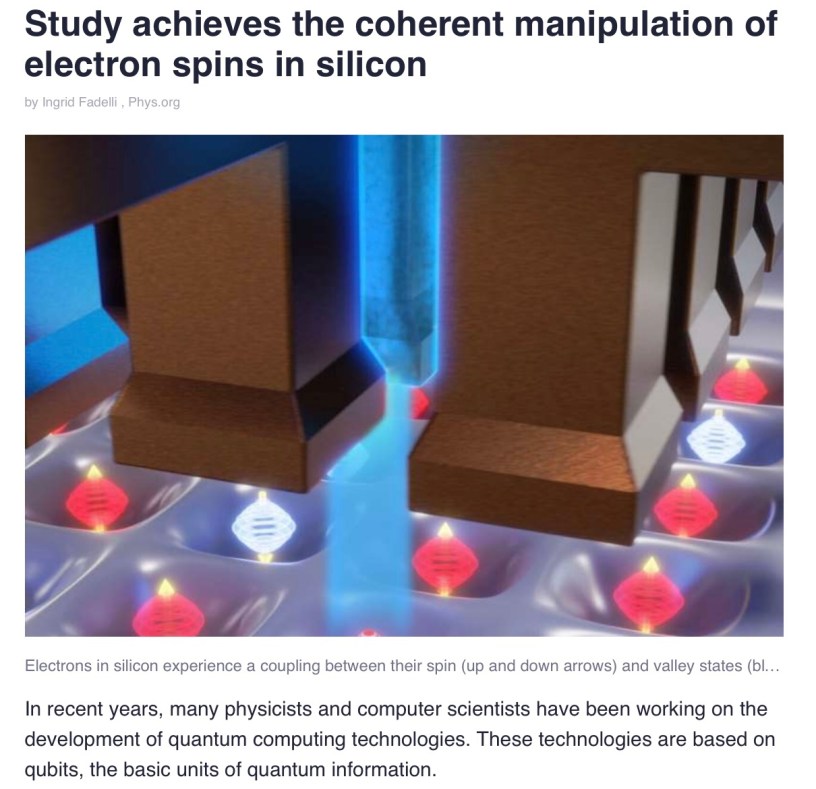
Electron spins confined in silicon quantum dots (i.e., tiny silicon-based structures) have shown particular promise as qubits, particularly due to their long coherence times, high gate fidelities and compatibility with existing semiconductor manufacturing methods. Coherently controlling multiple electron spin states, however, can be challenging.
— Read on phys.org/news/2023-01-coherent-electron-silicon.html
Study achieves the coherent manipulation of electron spins in silicon
 A New Theory of the Universe: Palindromic Entangled Elastic Time Strings Theory “