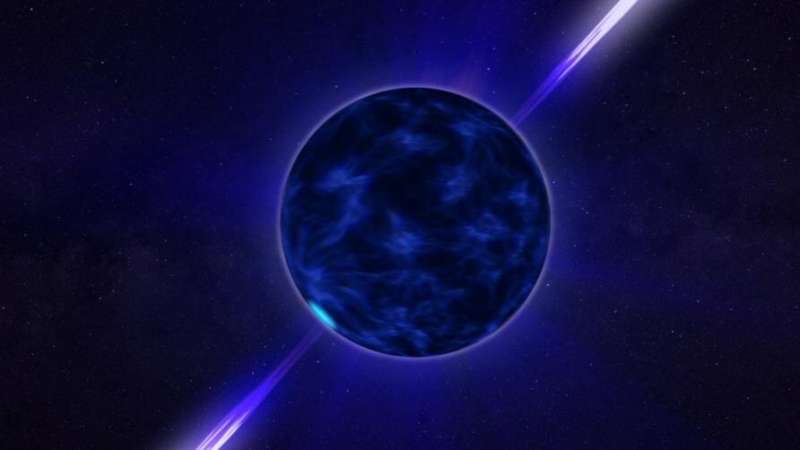
Using neutron stars to detect dark matter
— Read on phys.org/news/2021-10-neutron-stars-dark.html
…Neutron stars are the densest stars known to exist and form when giant stars die in supernovae explosions. Left behind is a collapsed core, in which gravity presses matter together so tightly that protons and electrons combine to make neutrons. With a mass comparable to that of the Sun—compressed into a 10km radius—one teaspoon of neutron star material has a mass of about a billion tons!
Extreme environment…
An extreme environment exhibits extreme conditions which are challenging to most life forms. These may be extremely high or low ranges of temperature, radiation, pressure, acidity, alkalinity, air, water, salt, sugar, carbon dioxide, sulphur, petroleum and many others. An extreme environment is one place where humans generally do not live or could die there. There are organisms referred to as extremophiles, that inhabit these spaces and are so well-adapted that they readily grow and multiply. Examples of extreme environments include the geographical poles, very dry deserts, volcanoes, deep ocean trenches, upper atmosphere, Mt Everest, outer space and other planets. The life that can live finely in these conditions, are very well adapted to these circumstances. It is in a way that the animal and land was made for each other. This adaptation also includes evolution of the animal of which is living there. Some times the life in the extreme habitat dies because humans are trying to find uses for this land or just for experimentation, and a lot of times humans affect the habitat by using the land space or with pollution.
This text uses material from Wikipedia, licensed under CC BY-SA
 A New Theory of the Universe: Palindromic Entangled Elastic Time Strings Theory “