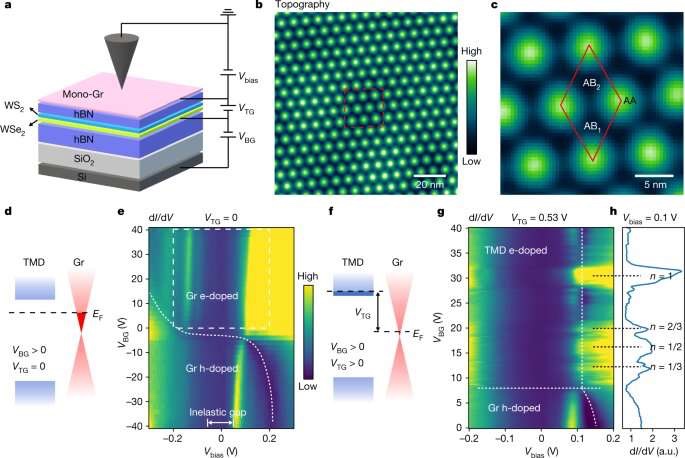
A non-invasive way to image Wigner crystals directly
— Read on phys.org/news/2021-10-non-invasive-image-wigner-crystals.html
Note: A Wigner crystal is the solid phase of electrons first predicted by Eugene Wigner in 1934. A gas of electrons moving in 2D or 3D in a uniform, inert, neutralizing background will crystallize and form a lattice if the electron density is less than a critical value. This is because the potential energy dominates the kinetic energy at low densities, so the detailed spatial arrangement of the electrons becomes important. To minimize the potential energy, the electrons form a bcc lattice in 3D, a triangular lattice in 2D and an evenly spaced lattice in 1D. Most experimentally observed Wigner clusters exist due to the presence of the external confinement, i.e. external potential trap. As a consequence, deviations from the b.c.c or triangular lattice are observed. A crystalline state of the 2D electron gas can also be realized by applying a sufficiently strong magnetic field.
Helium exists in liquid form only at extremely low temperatures. The boiling point and critical point depend on the isotope of the helium; see the table below for values. The density of liquid helium at its boiling point and 1 atm is approximately 0.125 g/mL
Helium-4 was first liquefied on 10 July 1908 by Dutch physicist Heike Kamerlingh Onnes. Liquid helium-4 is used as a cryogenic refrigerant; it is produced commercially for use in superconducting magnets such as those used in MRI or NMR. It is liquefied using the Hampson-Linde cycle
 A New Theory of the Universe: Palindromic Entangled Elastic Time Strings Theory “