Putting a new theory of many-particle quantum systems to the test
— Read on phys.org/news/2021-09-theory-many-particle-quantum.html
The basic idea behind hydrodynamics is to forget about the atoms and consider the fluid as a continuum,” said Marcos Rigol, professor of physics at Penn State and one of the leaders of the research team. “To simulate the fluid, one ends up writing coupled equations that result from imposing a few constraints, such as the conservation of mass and energy. These are the same types of equations solved, for example, to simulate how air flows when you open windows to improve ventilation in a room.”
“We set out to test the theory further, by looking at the dynamics of one dimensional gases with a wide range of interaction strengths,” said Weiss. “The experiments are extremely well controlled, so the results can be precisely compared to the predictions of this theory.
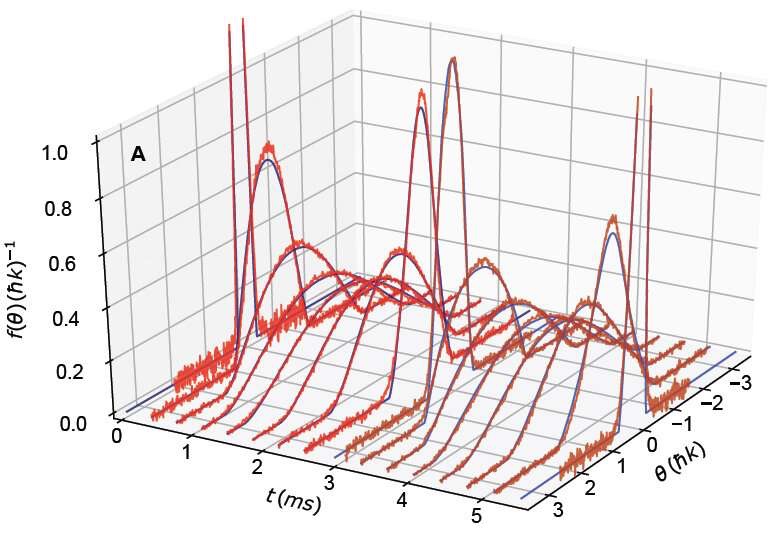
The research team uses one dimensional gases of interacting atoms that are initially confined in a very shallow trap in equilibrium. They then very suddenly increase the depth of the trap by 100 times, which forces the particles to collapse into the center of the trap, causing their collective properties to change. Throughout the collapse, the team precisely measures their properties, which they can then compare to the predictions of generalized hydrodynamics.
“Our measurements matched the prediction of theory across dozens of trap oscillations,” said Weiss. “There currently aren’t other ways to study out-of-equilibrium quantum systems for long periods of time with reasonable accuracy, especially with a lot of particles. Generalized hydrodynamics allow us to do this for some systems like the one we tested, but how generally applicable it is still needs to be determined.”….
 A New Theory of the Universe: Palindromic Entangled Elastic Time Strings Theory “