Experimental observations of dip poles
It has been long understood that dip poles migrate over time. In 1831, James Clark Ross located the north dip pole position in northern Canada. Natural Resources Canada (NRCan) tracked the North Magnetic Pole, which is slowly drifting across the Canadian Arctic, by periodically carrying out magnetic surveys to reestablish the Pole’s location from 1948 to 1994. An international collaboration, led by a French fundraising association, Poly-Arctique, and involving NRCan, Institut de Physique du Globe de Paris and Bureau de Recherche Geologique et Miniere, added two locations of the North Magnetic Pole in 2001 and 2007. The most recent survey determined that the Pole is moving approximately north-northwest at 55 km per year.
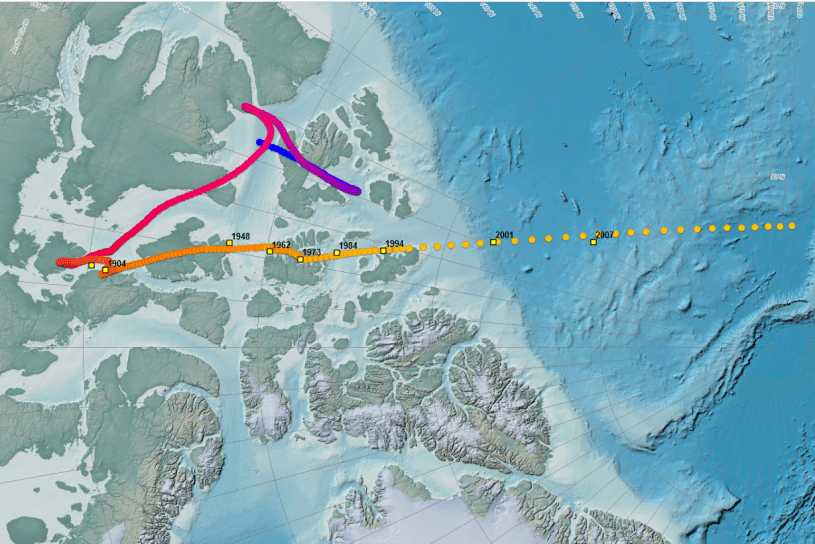
A web based portal views both the experimental and modeled pole locations.Observed north dip poles during 1831 – 2007 are yellow squares. Modeled pole locations from 1590 to 2020 are circles progressing from blue to yellow.
— Read on ngdc.noaa.gov/geomag/GeomagneticPoles.shtml
Experimental observations of dip poles
It has been long understood that dip poles migrate over time. In 1831, James Clark Ross located the north dip pole position in northern Canada. Natural Resources Canada (NRCan) tracked the North Magnetic Pole, which is slowly drifting across the Canadian Arctic, by periodically carrying out magnetic surveys to reestablish the Pole’s location from 1948 to 1994. An international collaboration, led by a French fundraising association, Poly-Arctique, and involving NRCan, Institut de Physique du Globe de Paris and Bureau de Recherche Geologique et Miniere, added two locations of the North Magnetic Pole in 2001 and 2007. The most recent survey determined that the Pole is moving approximately north-northwest at 55 km per year.
A web based portal views both the experimental and modeled pole locations.
Observed north dip poles during 1831 – 2007 are yellow squares. Modeled pole locations from 1590 to 2020 are circles progressing from blue to yellow.
 A New Theory of the Universe: Palindromic Entangled Elastic Time Strings Theory “